


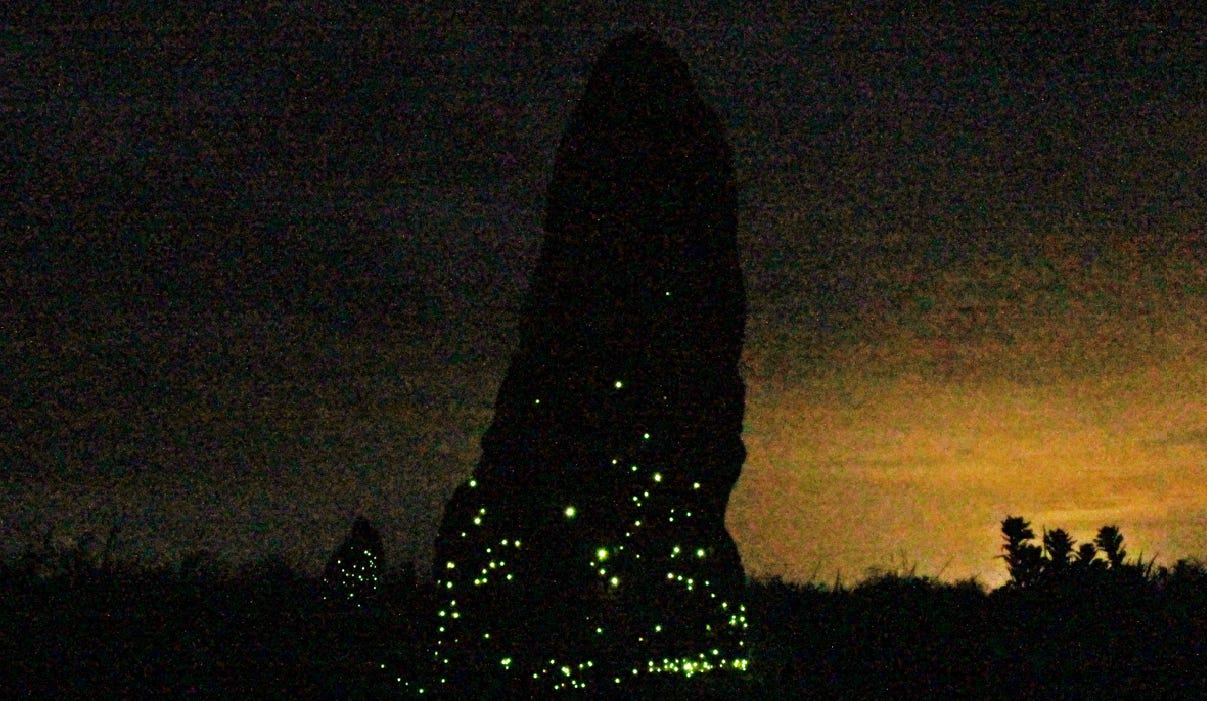
Picture a wild landscape in Brazil at night with giant termite mounds glowing green with the lures of predatory beetle larvae.
Seen from the skies above, would that pattern of life (and arguably intelligence) here on Earth read as wildlife, geology, or a city? Would it even be recognizable?
And what kinds of biological structures created by ecosystem engineers on other worlds could be potential technosignatures?
Rhat’s part of what Milton Mendonça explored at IAUS404: Advancing the Search for Technosignatures in March 2026.
About the Presenter
Milton de Souza Mendonça Jr. is a professor in the Department of Ecology at the Federal University of Rio Grande do Sul (UFRGS) in Porto Alegre, Brazil. An ecologist by training, he studies arthropod communities and plant–insect interactions, and he has long argued that his field belongs in astrobiology. In 2014 he proposed “metabiospheres,” sets of biospheres linked by the transfer of life between worlds, and he later co-authored the open-access review Astroecology: bridging the gap between ecology and astrobiology with Juliana Campos Meurer and Blue Marble Space’s Jacob Haqq-Misra.
Mendonça also contributed a video poster to IAUS404 on restoration ecology and “hippie aliens,” featured in an earlier poster roundup here on Planetary Perspectives.
More About Mendonça’s Work in Advancing the Search for Technosignatures
Technosignature research has generally treated humans as the only technological analog. Mendonça asked whether other species could serve too. Ecologists call species that create or strongly reshape habitats, changing resources for themselves and their neighbors, ecosystem engineers. He described two kinds:
Autogenic engineers alter habitats through their own bodies, as trees, kelp, and corals do.
Allogenic engineers physically rework living or nonliving materials, as earthworms, termites, and beavers do.
Some of this work is visible from orbit, including the Great Barrier Reef and an 850-meter beaver dam in northern Canada. On another world, Mendonça argued, large allogenic structures could blur the line between a structural biosignature and a technosignature. He pointed to Brazil’s luminous termite mounds, lit by click beetle larvae, and asked whether a scaled-up version might pass for city lights. To tell the two apart, he suggested tools from information theory, network theory, fractal geometry, landscape ecology, and urban studies.
The analog paper he mentioned as forthcoming, led by Meurer, is now available as an EarthArXiv preprint that has not yet been peer reviewed.
Key Takeaways
Every organism alters its surroundings, but ecosystem engineers do so strongly enough to create or remake habitat for other species.
Some engineered structures, from coral reefs to beaver dams, are large enough to see from space.
On another planet, large structures built by non-technological life could resemble technosignatures, so structure alone may not settle the question.
Mendonça proposed borrowing quantitative tools from landscape ecology and urban studies to separate the two.
Mendonça’s talk brings an ecologist’s caution to a field that often hopes technosignatures will prove less ambiguous than biosignatures: on Earth, the boundary between building and technology is already blurry. Readers who want the broader framework can start with the open-access Astroecology review and the analog-environments preprint.
This video was included in the proceedings of the International Astronomical Union (IAU) symposium #404, Advancing the Search for Technosignatures, hosted by Blue Marble Space.
Thanks for joining us here with Planetary Perspectives, an editorial endeavor and science communication project from Blue Marble Space.
