
Cosmic Clue: Where Would Self-Replicating Probes Be Hiding?
Alex Ellery on Solar System Technosignatures of Self-Replicating Probes for IAUS404

If an alien civilization ever sent machines to explore the galaxy, the most economical design would be a probe that builds copies of itself from raw material like asteroid and moon rock, spreading from star to star at almost no additional cost.
But, if such machines exist, then why haven’t we found any?
Perhaps, argues one engineer who is actually building self-replication technology in his own lab, we simply haven’t looked in the right places, and that’s part of what Alex Ellery presented during IAUS404: Advancing the Search for Technosignatures.
About the Presenter
Prof. Alex Ellery is a Canada Research Professor in the Department of Mechanical and Aerospace Engineering at Carleton University in Ottawa, where he directs the Centre for Self-Replication Research (CESER). Trained in physics, astronomy, and astronautics, he is the author of the textbooks An Introduction to Space Robotics and Planetary Rovers: Robotic Exploration of the Solar System.
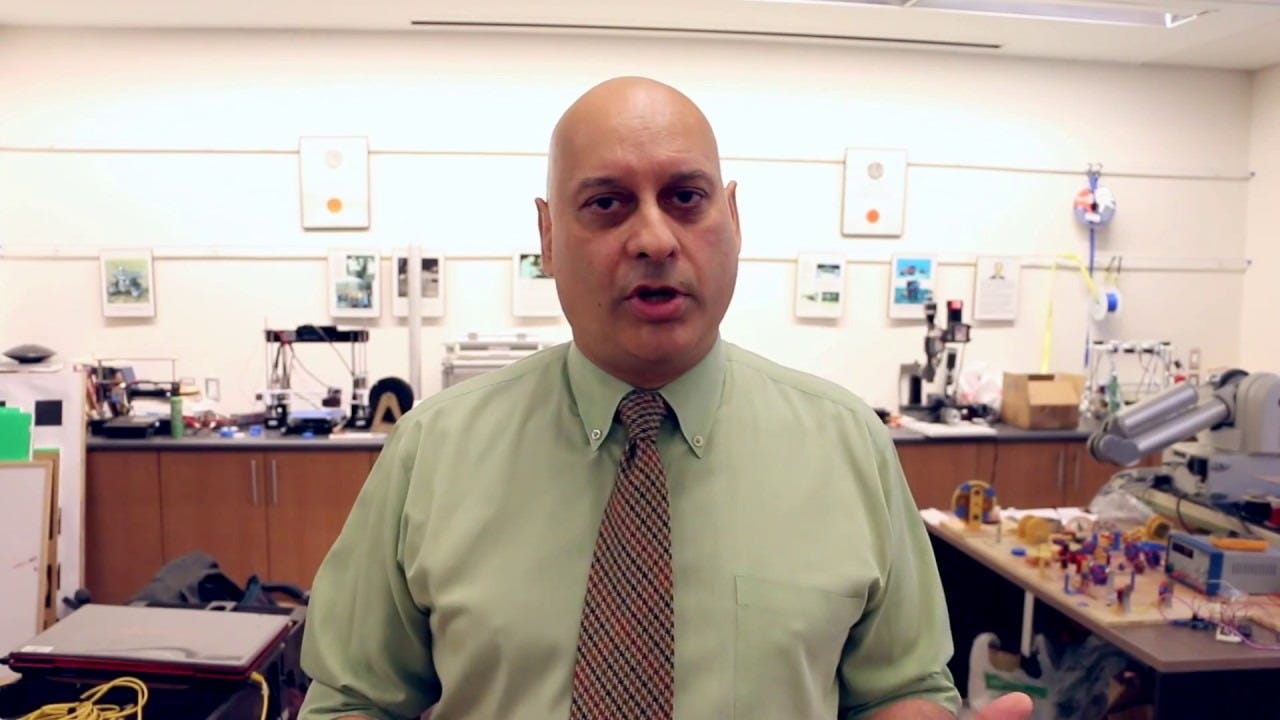
Ellery’s research spans space robotics, planetary rovers, in-situ resource utilization (using local planetary materials rather than launching everything from Earth), and biomimetic design. His signature pursuit is the self-replicating machine: a robotic system capable of mining, processing, and manufacturing copies of itself from lunar or asteroidal material. His group has demonstrated key steps in this chain, including extracting aluminum from lunar regolith simulant and 3D printing it into functional hardware.
That engineering background gives his SETI arguments a somewhat unique grounding: he reasons about alien probes the way a builder would.
More About Ellery’s Work in Advancing the Search for Technosignatures
Ellery’s argument begins with economics, which he calls as universal as mathematics. Because self-replication amortizes the initial capital cost of a probe across endless generations of free copies, he contends that von Neumann probes are the only rational way to explore a galaxy. And if that’s true, probes should have visited our solar system long ago (assuming, of course, that any advanced alien civilizations choosing to build them have existed in the past).
The absence of obvious evidence suggests any technosignatures are either indistinguishable from natural processes, erased by them, or may be deliberately hidden.
Walking inward from the solar system’s edge, Ellery surveyed where a visiting probe’s traces might appear:
Deceleration burns on approach, potentially detectable from light-years away since the energy would be beamed toward us
The Oort Cloud: unpromising, he argues, due to poor resource diversity and scarce sunlight
The solar gravitational focus: a plausible site for a communications relay, though one requiring periodic refueling
The Kuiper Belt: fuel-rich but far from the interesting inner solar system
Jovian orbit: attractive for refueling, since Jupiter’s atmosphere offers abundant helium-3 and deuterium
The asteroid belt: dynamically stable enough for dormant “lurkers” to hide for billions of years
Drawing on his lab’s own extraction chemistry, Ellery showed that most asteroid processing (converting metals to gaseous carbonyls, weathering silicates with acid) would leave few detectable traces. The Moon is a different story. Lunar industrialization could leave measurable fingerprints, such as anomalous thorium depletion relative to neodymium and barium from lunar-built nuclear reactors, analogous to how the natural Oklo reactor in Gabon was discovered. His most provocative suggestion: a long-departed probe may have buried a “gift” (a universal constructor, the ultimate technology) beneath M-type asteroid metal deposits on the Moon, discoverable only once a species becomes technologically capable of lunar mining (brings Arthur C. Clarke’s writing to mind!).
These ideas are developed in detail in his recent paper, Technosignatures of Self-Replicating Probes in the Solar System.
Key Takeaways
Economics, along with physics, may dictate how galactic exploration happens: self-replicating probes drive the specific cost of information returned toward zero.
Most asteroid mining by a self-replicating machine would be nearly impossible to distinguish from natural processes; exceptions include excess montmorillonite (bentonite clay), porcelain, and plastics.
The Moon is the best target for a directed search: isotopic anomalies from lunar-resource nuclear reactors would be readily detectable technosignatures.
Ellery’s lab has already extracted aluminum from lunar regolith simulant and 3D printed it, demonstrating that self-replication technology is entirely possible even for our own near future.
If we ever do make contact, Ellery predicts, it will be with artificial intelligence rather than biological beings.
Ellery’s talk exemplifies a growing shift in technosignature science: away from listening exclusively for distant radio beacons and toward searching our own cosmic backyard for physical artifacts. As lunar industrialization moves from speculation toward policy, his proposal that the Moon may hold buried evidence, or even a deliberate gift, gives that enterprise an unexpected scientific stake.
This video was included in the proceedings of the International Astronomical Union (IAU) symposium #404, Advancing the Search for Technosignatures, hosted by Blue Marble Space. Stay tuned as we explore the boundaries of knowledge in technosignature science!
Thanks for joining us here with Planetary Perspectives, an editorial endeavor and science communication project from Blue Marble Space.

Love publishing this one! Seems wild to think that not only could self-replicating probes be "out there" but that they might even be far close than many people would think.