
Could Alien Megastructure Starshades Serve as Signs of Technological Alien Civilizations?
Claudia Skoglund on Starshades as Technosignatures for IAUS404

There are many reasons that an alien civilization may wish to develop a colossal starshade to block their own world from some of their local starlight.
It could be to avoid issues with radiation or stellar ejecta that could cause them harm. Perhaps their star has brightened too much for their own survival. Perhaps they’ve elected a much different form of life that requires less starlight.
For instance, every star in the galaxy is slowly getting brighter, and for any civilization patient enough, thoughtful enough, and lucky enough to survive over long timescales, star brightening may become an existential problem at some point.
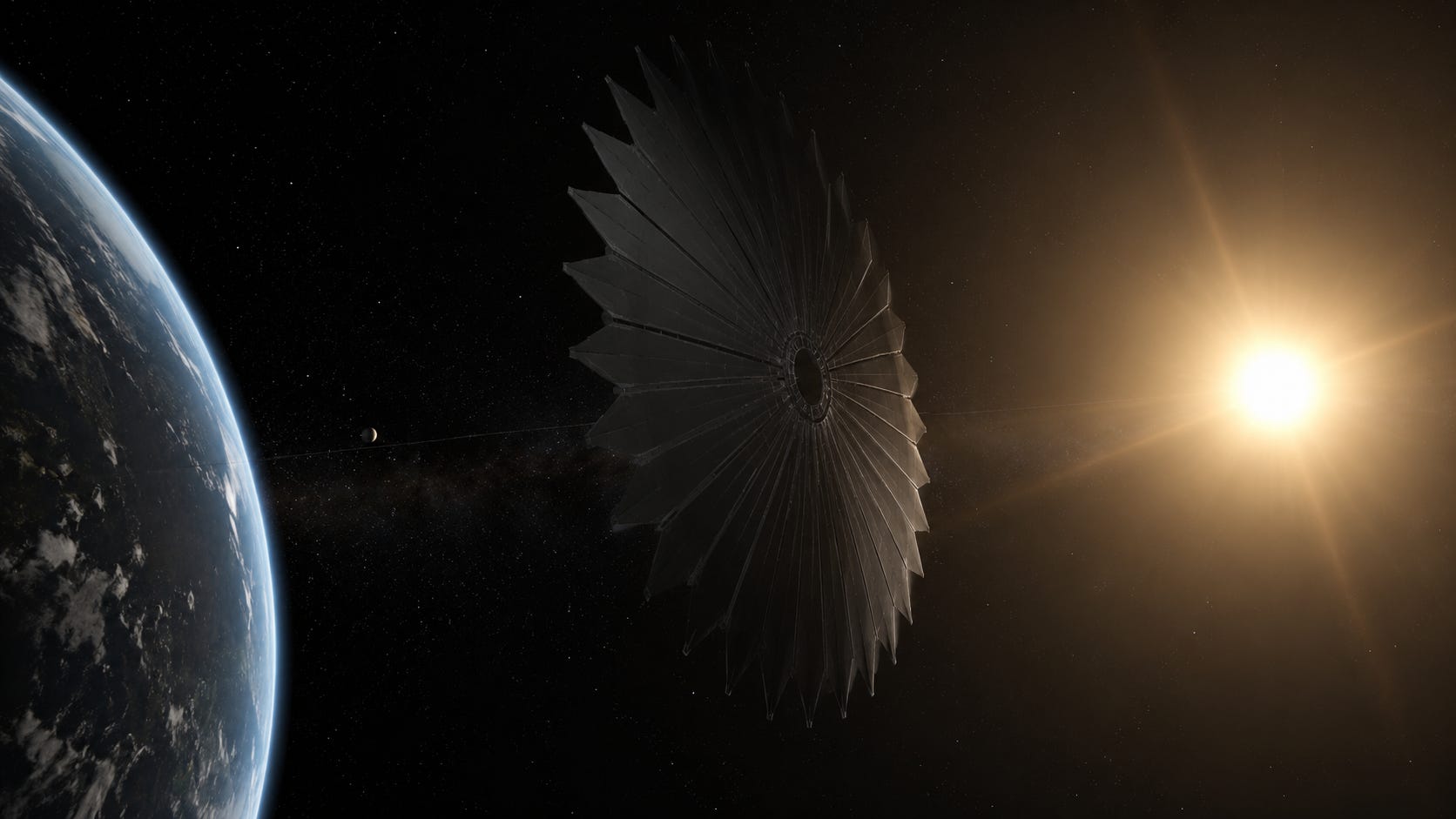
What if an advanced alien society solved it by building a colossal sunshade in space, a moon-sized or even planet-sized reflective disc to deflect excess starlight and keep their world livable for themselves? And what if we already have a telescope on the drawing board that might catch the glint of such a structure? Those questions sit at the heart of what Claudia Skoglund presented during IAUS404: Advancing the Search for Technosignatures.
About the Presenter
Claudia Skoglund is a PhD student in the Supernovae group at the Department of Astronomy, Stockholm University, where her primary research focuses on observations of peculiar supernovae and untangling the origins of those stellar explosions. She is affiliated with the Oskar Klein Centre at Stockholm’s AlbaNova University Center.
Her foray into technosignature science began during her bachelor’s thesis, completed under the supervision of Alexander J. Mustill, a Senior Research Fellow at Lund Observatory, Lund University, who specializes in exoplanet dynamics and the effects of stellar evolution on planetary systems. That undergraduate project evolved into a peer-reviewed paper, published in Monthly Notices of the Royal Astronomical Society in late 2025.
More About Skoglund’s Work in Advancing the Search for Technosignatures
Stars are not static objects.
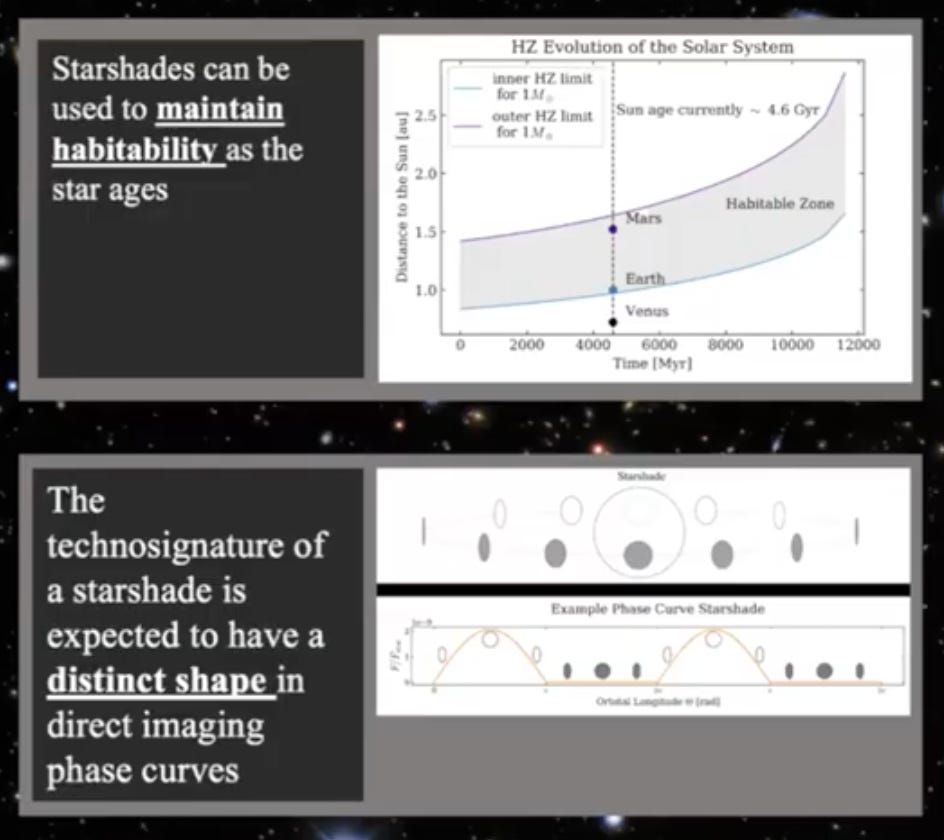
As they age along what astronomers call the main sequence, their luminosity steadily increases. For Earth, that means our planet will eventually be pushed outside the Goldilocks Zone, the band of orbital distances where liquid water could exist on a terrestrial planet’s surface. The same slow warming applies to every star in the galaxy that hosts orbiting worlds.
Skoglund’s research asks a pointed question:
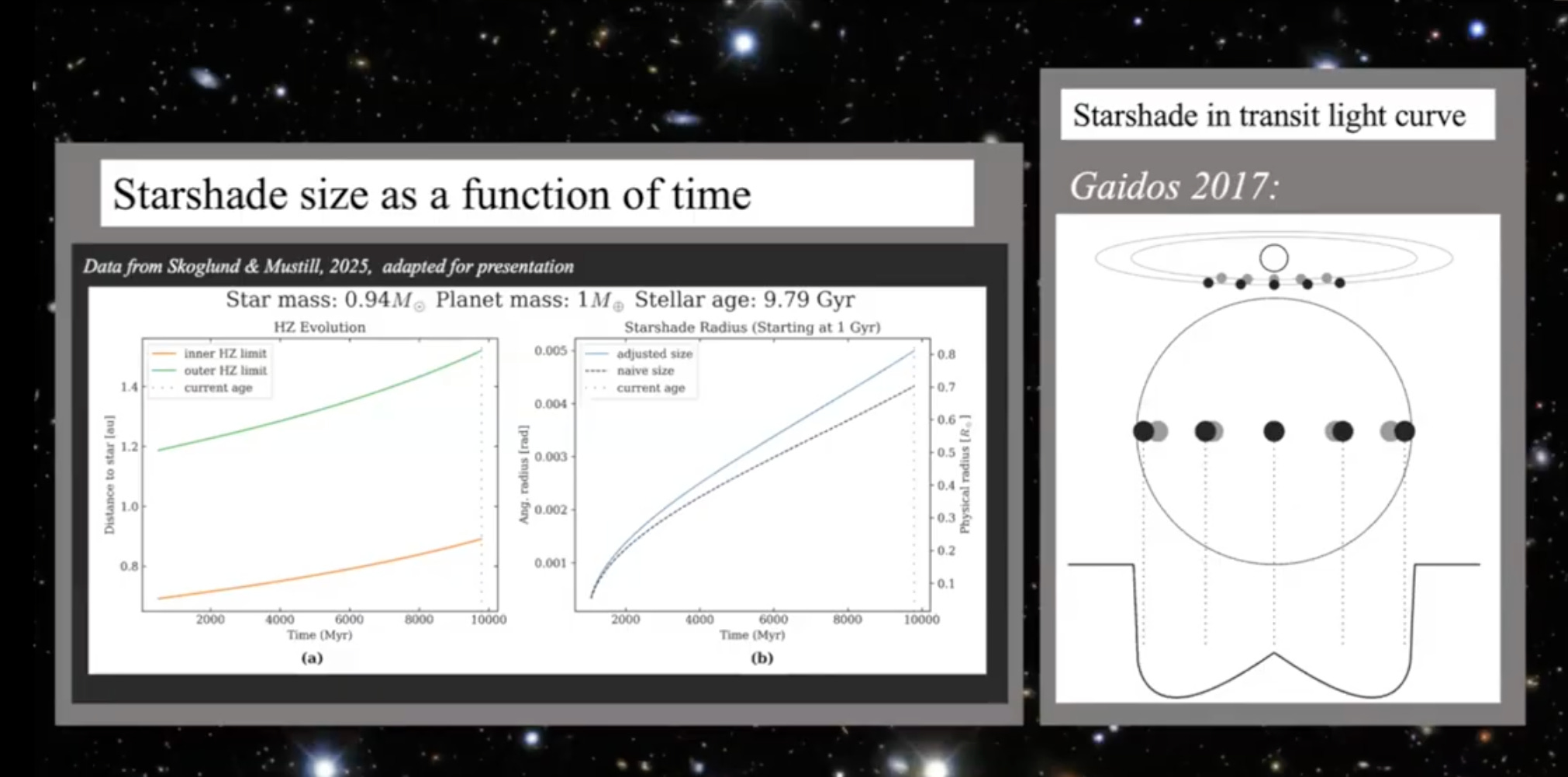
If a sufficiently advanced extraterrestrial civilization recognized this problem, might they engineer a solution, and could that solution be visible to us? The candidate technology she examines is a “starshade”: a large, highly reflective disc placed at the inner Lagrange point (L1) between a star and its planet, the gravitational sweet spot where the structure would naturally hover and intercept incoming stellar radiation. As a star grows brighter over millions of years, the required shade would need to grow too, eventually reaching sizes comparable to the planet itself.
Prior work by astronomer Eric Gaidos in 2017 showed that such a megastructure might leave an unusual fingerprint in a planet’s transit light curve, the dip in starlight measured when a planet crosses in front of its host star.
Skoglund and Mustill took the next logical step:
Rather than looking at transits, they modeled what a starshade would look like in direct imaging, specifically through a quantity called a phase curve.
A phase curve tracks the total reflected light from a planetary system as the planet moves through its orbit, presenting different faces to the observer, much like the Moon’s phases seen from Earth. For an ordinary planet, that curve has a characteristic smooth shape. A planet-starshade system would look quite different:
The starshade’s reflective face, when turned toward us, would produce a sharp, amplified brightening far above what a bare planet could generate.
As the planet moves in its orbit and the dark, non-reflective back of the shade faces us, the system would drop to near-zero brightness, creating a distinctive steep edge in the phase curve.
The combined signal of the shaded planet and the shade itself produces a curve shape that is both more luminous and more sharply asymmetric than any normal planetary signature.
To assess real-world detectability, the team applied their model to the target star list for NASA’s upcoming Habitable Worlds Observatory (HWO), a flagship space telescope concept recommended by the National Academies’ 2020 Decadal Survey and planned for launch in the 2040s. HWO’s primary mission is to directly image Earth-like planets in habitable zones and search their atmospheres for signs of life. A key design parameter is the telescope’s inner working angle (IWA), which determines how close to a star the instrument can see without being blinded by stellar glare.
Skoglund’s results showed that the IWA matters enormously for starshade detection:
At an IWA of 45 milliarcseconds, around 96.7% of HWO’s target stars would show a phase-curve anomaly large enough to exceed the telescope’s detection threshold.
At an IWA of 60 milliarcseconds (closer to the current baseline), only around 70.8% of targets would clear the threshold, with some signatures too marginal to distinguish confidently.
Key Takeaways
Alien starshades, designed to shield a planet from a brightening star and maintain habitable temperatures, would produce a distinctive and amplified phase curve in direct imaging, one that looks nothing like a normal planet.
The upcoming Habitable Worlds Observatory could detect these signatures for the majority of its target stars, particularly if engineers achieve a small enough inner working angle.
The inner working angle is a critical design choice: reducing it from 60 to 45 milliarcseconds boosts the fraction of detectable targets from roughly 71% to nearly 97%.
Potential false positives exist, including highly reflective cloud formations and polar ice caps, but moons and planetary rings do not appear to mimic the starshade signature closely.
This work represents a new detection pathway for megastructure technosignatures, complementing earlier transit-based approaches and broadening the suite of observational strategies SETI researchers can pursue.
As humanity prepares to build telescopes capable of directly imaging Earth-like worlds, the possibility of reading technosignatures in phase curves opens an entirely new dimension to the search for intelligence.
If any civilization has had the time and foresight to engineer a planetary sunshade, the Habitable Worlds Observatory may be our first instrument sensitive enough to notice. The work of researchers like Skoglund and Mustill ensures that when such data arrives, we will know what anomaly to look for in the noise.
This video was included in the proceedings of the International Astronomical Union (IAU) symposium #404, Advancing the Search for Technosignatures, hosted by Blue Marble Space.
Stay tuned as we explore the boundaries of knowledge in technosignature science!
For more on this work, read the paper by Skoglund and Mustill:
Thanks for joining us here with Planetary Perspectives, an editorial endeavor and science communication project from Blue Marble Space.

Fascinating angle on looking for a particular megastructure technosignature!
My guess though is that the increasing luminosity of a host star is so gradual that biological evolution would develop a natural solution. If that natural solution entails the extinction of the civilization-building species then a megastructure solution might be developed, but just imagine the potential political arguments between those convinced of the existential nature of the threat from rising luminosity and those who are not so convinced.
Small scale solutions would also be developed and implemented long before a megastructure solution and could conceivably eliminate any need for a star shade.
While proving such a starshade may be impossible with current technology, at the rate we're advancing, it may very well become possible in the coming decades. Technology in the Kepler Observatory, launched in 2009, was science fiction in 1995, the year the first exoplanet was discovered.