



A Planetary Perspective by Aruna Devi TM
One of the biggest challenges in astrobiology comes down to a frustrating fact of time: the possible signs of ancient life don’t keep well.
Whether on early Earth or on Mars, evidence of past biology is gradually erased. Radiation, heat, pressure, and chemical reactions break down cells and molecules over millions and billions of years. What remains is rarely a perfect fossil or an intact biological structure. Most of the time, we are left with fragments.
For many years, biosignature research focused on identifying well-preserved signs of life: recognizable fossils, complex organic molecules, or chemical patterns that strongly suggest biological origins. But perfect preservation is rare, especially on Mars, where intense surface radiation and oxidizing conditions continuously degrade organic matter.
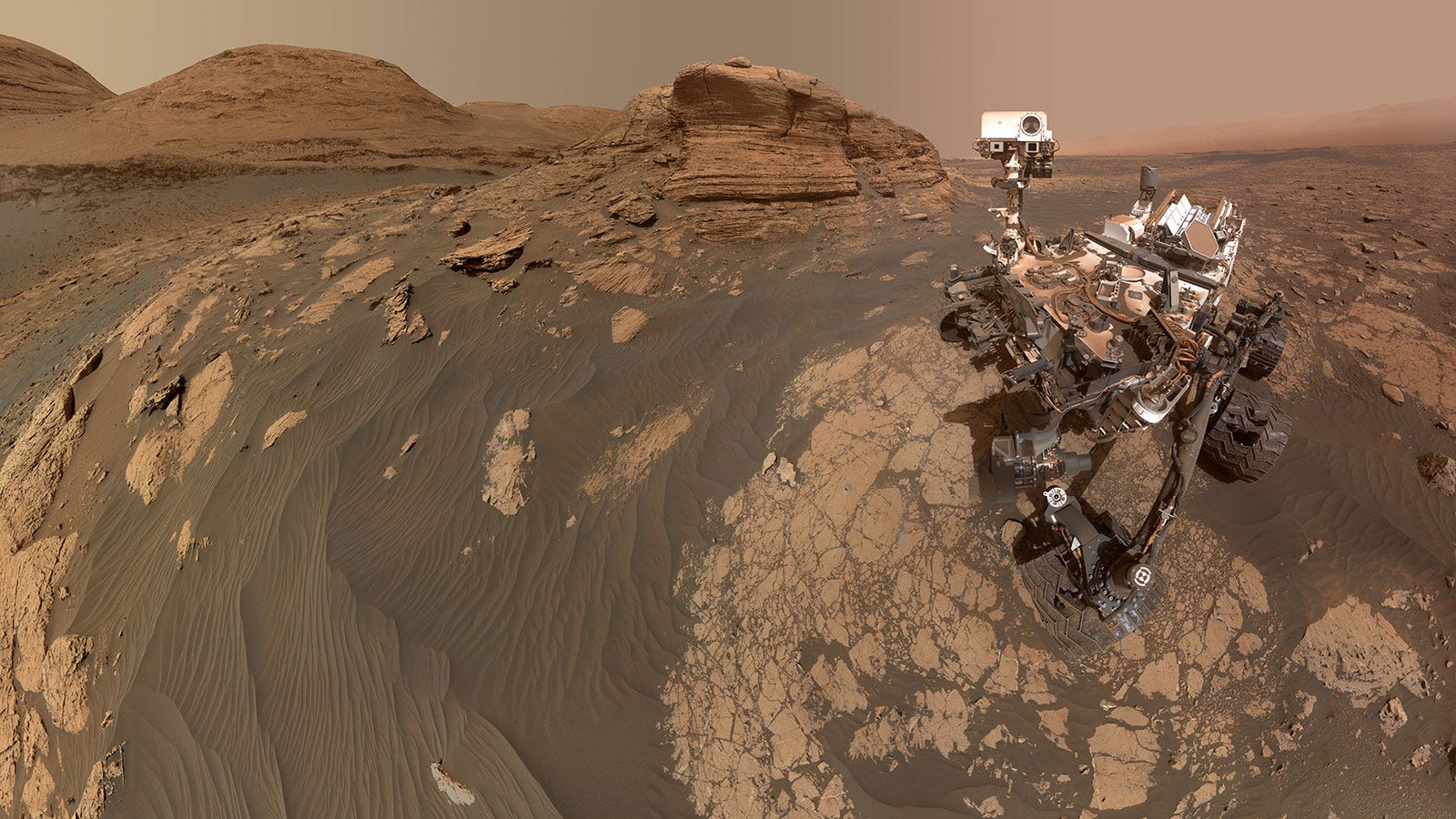
Recent research has sharpened just how difficult it is to interpret these damaged signals of possible past life.
A 2026 study in Astrobiology examined ancient alkanes preserved in a Martian mudstone and asked whether their measured abundance could point toward a biological origin. That same month, NASA Science News reported that although complex organic molecules have been detected on Mars, non-biological processes alone do not fully explain the observed chemical complexity at this time.
These findings don’t confirm life, but they show that interpreting Martian organics requires careful, structured analysis.
This raises an important question: if signs of life once existed on Mars but are now heavily altered, can we still detect them?
I believe the answer may lie in learning how to read fragments more carefully. Instead of treating damaged molecules as meaningless noise, we can ask whether the pattern of damage itself still contains information.
The Stability of Lipids and What Survives
This idea builds on decades of biosignature research.
A strong example comes from the history lipid biosignature analysis. Lipids are a range of molecules that include fats, waxes, and a number of other organics. They are the molecules that form cell membranes, and they are far more stable over time than DNA or proteins. Even after an organism dies, parts of its lipid structures can survive in rocks for billions of years. Scientists have used these molecular remnants to reconstruct early life on Earth. Although heat and pressure may modify them, their core carbon framework often remains identifiable, and organic geochemists have even learned, through both laboratory and computational studies, how certain biological lipids produce recognizable molecules when altered.
Beyond individual molecules, researchers are increasingly focusing on chemical complexity as a measurable feature of living systems. A 2023 PNAS research article, “On the Roles of Function and Selection in Evolving Systems”, argues that functional information provides a universal framework for understanding complexity in evolving systems. Biosignatures, in this view, are not random chemical traces but structured signals of life. Biological systems produce distinct distributions of molecular complexity that are unlikely to arise from random chemistry alone. Rather than looking for a single compound, this approach examines the overall structure and diversity of organic molecules within a sample.
At the same time, environmental processes complicate interpretation.
Radiation can fragment organic compounds, and geological reactions can rearrange atoms in ways that mimic biological signals. Studying terrestrial analog environments, such as deserts and volcanic regions, is essential for understanding how Martian conditions might alter organic materials. These studies show that environmental stress significantly modifies biosignatures, but often in patterned and rule-based ways.
Where AI Comes In
This is where artificial intelligence may offer practical support.
AI is particularly effective at identifying patterns in complex datasets. In biosignature research, we often collect multiple layers of information: chemical composition, isotopic ratios, mineral associations, radiation exposure levels, and imaging data. Analyzing all these variables together is difficult using traditional methods alone.
Instead of searching only for intact molecules, we can use AI to study how biological molecules change under stress. When radiation breaks apart a molecule, it does not do so randomly. The fragmentation follows chemical rules determined by the molecule’s original structure. If we understand these fragmentation patterns, we may be able to recognize the “echo” of a biological system even after significant degradation.
A Three-Step Research Framework
To explore this concept, I propose a three-step research approach.
First, we build a reference library using molecules from extremophile microorganisms (organisms that survive in harsh environments on Earth and can serve as analogs for potential life on Mars).
Second, we simulate environmental stress in the laboratory. We expose these biological molecules to Mars-like radiation and chemical conditions, carefully measuring how their structures change over time. It might take a lot of time to produce meaningful changes, but starting soon will allow for learning about the alterations through time as much as possible (within the extent of feasibility).
Third, we train machine learning models on this controlled degradation data. The model learns the relationship between intact biological molecules and their damaged fragments. When new data from Martian samples become available, AI systems could compare observed patterns against experimentally generated ones. Instead of relying only on intact biosignatures, we would evaluate structured fragmentation patterns.
This approach aligns with the broader direction of the field.
The February 2026 Astrobiology findings highlight the need for improved frameworks to distinguish biological from non-biological organics. The PNAS work on functional information emphasizes chemical complexity as a measurable property of life. And terrestrial analog research continues to prove essential for interpreting Martian chemistry responsibly. Together, these studies suggest that more integrated, data-driven methods are needed.
AI models must be trained on reliable data, and their conclusions must remain scientifically interpretable. Any biological interpretation must always be tested against plausible non-biological explanations. This is not yet a fully developed detection system, but a research direction that aims to strengthen how we interpret complex and damaged records.
A Shift in Perspective
What excites me about this direction is a shift in perspective already emerging within the field. Rather than searching only for rare, perfectly preserved fossils, many researchers are increasingly focusing on structured chemical patterns within fragments of degraded material. This approach builds on established geochemical methods while integrating new computational tools to interpret complex chemical data.
Work within the framework of agnostic biosignatures — including research led by Sarah Stewart Johnson and her collaborators — is already exploring how patterns in chemical complexity may reveal biological processes even when traditional biosignatures are heavily altered. In this view, the record of life may be incomplete, but it is not necessarily unreadable. Signals of biological organization may still persist within chemical fragments, waiting for improved analytical and computational methods capable of decoding them.
Life interacts with its environment in organized ways. Even when radiation and time erase obvious features, traces of that organization may persist. By integrating laboratory simulations, terrestrial analog research, chemical complexity analysis, and AI-based pattern recognition, we may improve our ability to interpret ancient environments — and possibly recognize evidence of life beyond Earth.
References
Pavlov, A. A., Freissinet, C., Glavin, D. P., et al. (2026). Does the Measured Abundance Suggest a Biological Origin for the Ancient Alkanes Preserved in a Martian Mudstone? Astrobiology, 26(2). https://journals.sagepub.com/doi/10.1177/15311074261417879
NASA (2026, February 6). Study: Non-Biologic Processes Don’t Fully Explain Mars Organics. NASA Science News. https://science.nasa.gov/blogs/science-news/2026/02/06/nasa-study-non-biologic-processes-dont-fully-explain-mars-organics/
Wong, M. L., Cleland, C. E., Arend, D. Jr., Bartlett, S., Cleaves, H. J. II, Demarest, H., Prabhu, A., Lunine, J. I., & Hazen, R. M. (2023). On the Roles of Function and Selection in Evolving Systems. Proceedings of the National Academy of Sciences, 120(43), e2310223120. https://www.pnas.org/doi/10.1073/pnas.2310223120
Aruna Devi TM is a passionate space enthusiast and emerging scholar in astrobiology and space technology. A recipient of the prestigious Dr. Kalpana Chawla Scholarship, she completed her formal education at the International Space University, where she participated in the Space Studies Program. In addition, she has pursued several professional space courses at leading institutions, including the University of Oxford and the Indian Institute of Astrophysics, further strengthening her expertise in interdisciplinary space sciences.
Her research focuses on the detection of life beyond Earth, with particular emphasis on the sulphur cycle on Mars and the icy moons of the outer solar system such as Enceladus. She has presented her work at international conferences including the International Astronomical Union General Assembly, the Mars Society Convention, and AbSciCon, where she explored the role of artificial intelligence in analyzing biosignatures.
Professionally, Aruna has served as a STEM Ambassador at Brahmastra Aerospace & Defense Pvt. Ltd and contributed to outreach initiatives at the International Center for Astronautical Development. She is committed to advancing space education and inspiring the next generation of explorers.
Thanks for joining us here with Planetary Perspectives, an editorial endeavor and science communication project from Blue Marble Space.

This is quite a unique perspective in biosignature exploration on Mars. We can use the propose AI based framework to build a sort of time machine that allows us to create patterns and relationships that are not visible anymore.