


Imagine a drunkard searching for his lost house key under a streetlamp, not because he dropped it there, but because it’s the only spot he can see.
It’s a century-old parable about the biases baked into any search, and it’s part of what Jacob Haqq-Misra presented at IAUS404: Advancing the Search for Technosignatures in March 2026.
About the Presenter
Jacob Haqq-Misra is a research scientist at Blue Marble Space, and he served as the chair of the scientific organizing committee for IAUS404.
He holds a Ph.D. in meteorology and astrobiology from Penn State University, and his research spans planetary habitability, atmospheric science, the ethics of space settlement, and the search for technosignatures, evidence of technology beyond Earth.
He is also the author of several books, including Sovereign Mars: Transforming Our Values through Space Settlement, and outside the lab he plays drums and vibraphone in the band Mysterytrain.
More About Haqq-Misra’s Work in Advancing the Search for Technosignatures
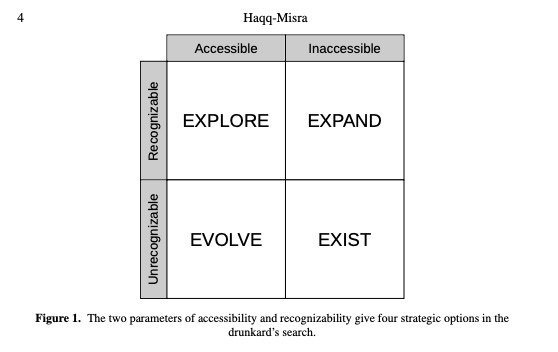
Haqq-Misra’s poster borrows a classic metaphor from the philosophy of science, sometimes called the drunkard’s search, to organize the many possible strategies for finding technosignatures into a simple two-by-two matrix.
The first axis is accessibility: is the thing we’re searching for even within the region of space our instruments can currently reach? The second is recognizability: would we know it if we saw it, given the sensors and analysis methods we have today?
The matrix then has four quadrants:
Explore (accessible and recognizable): keep scanning known targets with current tools, such as radio SETI surveys or searching for solar system artifacts.
Expand (recognizable but out of reach): build bigger, more sensitive instruments and add new targets, the strategy behind missions like the Habitable Worlds Observatory.
Evolve (in reach but not yet recognizable): develop new theoretical frameworks and detection methods to catch technosignatures we currently have no way to identify.
Exist (neither accessible nor recognizable): wait and hope, since there’s no clear path forward with current understanding.
Since presenting the poster, Haqq-Misra has expanded the argument into a full paper for the IAUS404 proceedings, tracing the streetlight metaphor back through Cold War-era SETI conversations, including a 1971 exchange between Francis Crick and Carl Sagan.
The paper also connects each strategy to a different set of assumptions about the Fermi paradox: “Explore” implies that technosignatures are within reach and we’ll find them if we keep looking, while “Exist” implies we may be unable to find them even if they’re out there.
Key Takeaways
A simple two-parameter framework, accessibility and recognizability, sorts every technosignature search strategy into one of four categories: Explore, Expand, Evolve, or Exist.
The metaphor of searching under a streetlight for lost keys, formally called the drunkard’s search, has a documented history in SETI discourse going back to at least a 1971 Soviet Armenia conference.
Which strategy a researcher favors often reflects an underlying, largely subjective assumption about how likely technosignatures are to exist and where they might be found.
The framework doesn’t tell scientists which strategy will succeed, but it offers a shared vocabulary for weighing trade-offs between searching harder, searching wider, or building new kinds of detectors.
Haqq-Misra’s framework offers a useful map for a field that spans radio astronomy, exoplanet spectroscopy, and solar system exploration all at once. Curious readers can find the full argument, including the matrix’s connection to the Nine Axes of Merit used elsewhere in technosignature science, in his paper “Framing the Possibility Space for Technosignature Searches,” published to arXiv as part of the IAUS404 proceedings.
This video was included in the proceedings of the International Astronomical Union (IAU) symposium #404, Advancing the Search for Technosignatures, hosted by Blue Marble Space.
Thanks for joining us here with Planetary Perspectives, an editorial endeavor and science communication project from Blue Marble Space.
