
Grading Galactic Beacons: Could Alien Civilizations Signal Us Through Transit Patterns?
Ranger Liu on Transit Information Density as an Artificiality Metric for IAUS404


Exoplanet hunters have catalogued thousands of worlds by watching stars flicker as planets cross their faces, but what if that same flickering could carry a message?
What if an extraterrestrial civilization, knowing that any astronomically literate species would be watching for transits, chose that very channel to broadcast their existence?
That provocative question is at the heart of what Ranger Liu presented during IAUS404: Advancing the Search for Technosignatures.
About the Presenter
Ranger Liu is currently a second-year PhD student in the Department of Astronomy at the University of Washington in Seattle, where they study technosignatures as part of the broader search for extraterrestrial intelligence. Liu holds dual bachelor’s degrees in Astrophysics and Computer Science from Columbia University and an MFA in Design and Technology from Parsons School of Design: a combination that positions them unusually well to think across disciplines about how intelligence communicates through structured signals.
We’ re also very proud to share that Ranger took part in the Young Scientist Program at Blue Marble Space in 2021, where they worked with Dr. Jim Cleaves!

Beyond their scientific work, Liu is the founder of UW Planetarium Arts, a graduate-led outreach initiative within the UW Astronomy Department that builds interdisciplinary collaborations between the arts and astronomical sciences. Their broader creative practice uses scientific frameworks as material for sonic, visual, and performative work.
Liu’s research sits at the productive intersection of SETI theory, information science, and exoplanet science. This talk represents early-stage doctoral work developing new mathematical tools for identifying artificial signals in transit data.
More About Liu’s Work in Advancing the Search for Technosignatures
The transit method (watching a star dim as a planet crosses its disk) has become the most productive planet-detection technique in the history of astronomy, yielding thousands of confirmed exoplanets. Liu’s central argument is that any astronomically capable civilization would recognize this, and might deliberately exploit transits as a broadcast medium.
The scenario Liu envisions involves an artificial occulting object in a stable orbit—think of it as a variable-aperture megastructure, perhaps something like a solar shade—capable of changing its size to modulate the depth of successive transit events. The transits would occur at regular intervals dictated by the orbital period, but their depths could vary to encode information, much as dots and dashes encode Morse code. Individually, each transit might look unremarkable; the message would emerge only from the pattern across many events.
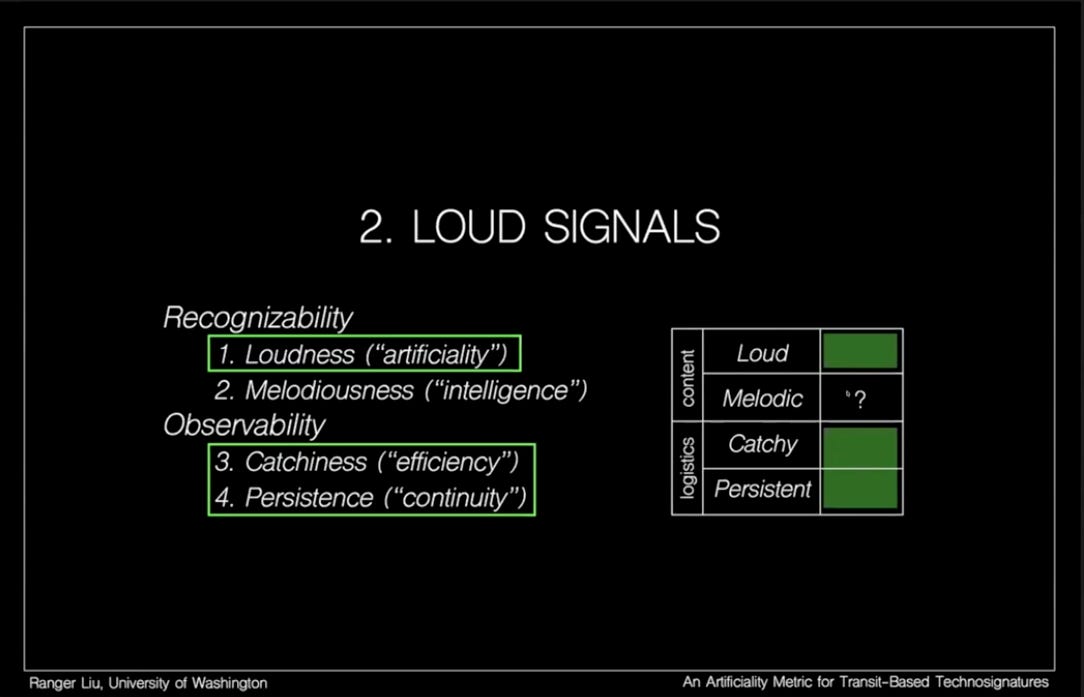
To evaluate how well any such pattern could serve as a beacon, Liu developed a four-criterion framework: deliberately constructed from the broadcaster’s perspective rather than the observer’s. Drawing playfully on the analogy of a street musician trying to be heard above city noise, the four criteria are:
Loudness: the signal must be clearly distinguishable from both periodic and random transit patterns. It must stand out as unambiguously artificial.
Melodiousness: the signal should exhibit intentional mathematical or linguistic structure, demonstrating knowledge behind the transmission.
Catchiness: an observer should be able to recognize the pattern within a relatively small number of observed transits, without requiring impractically long observation windows.
Persistence: the signal should contain no long stretches without transits, so it doesn’t favor any particular observation window.
The first two criteria concern the content of the signal; the second two address its temporal logistics. Liu notes that catchiness and persistence are relatively easy to engineer for. The harder design challenge is satisfying both loudness and melodiousness simultaneously.
“The ideal beacon is equivalent to somebody who is playing a very loud and very well-known tune on the street—maybe from dawn until dusk—which would probably be pretty annoying to hear. But that’s the goal here.”
—Ranger Liu, ~4:56
To quantify loudness, Liu introduces transit information density (TID), a metric borrowed from information theory. TID is defined as the number of planets needed to reproduce a transit pattern based purely on periodicities, divided by the total number of transit events observed. A natural periodic system drives TID toward zero as more transits accumulate; random patterns cluster in a characteristic middle regime. Signals that fall above the random regime, or between random and periodic, register as genuinely anomalous, and potentially artificial.
Liu tested this framework against several candidate signals. A heuristic algorithm optimized for maximum TID produces a “loud” signal that scores well on catchiness and persistence. But the pattern turns out to have no discernible mathematical structure, making it essentially un-melodic: a loud, erratic air horn rather than a tune. The Thue-Morse sequence—a well-known binary fractal structure that is aperiodic but deeply ordered, sometimes described as a more fractal cousin of the Fibonacci sequence—scores well on melodiousness and persistence, but unfortunately falls squarely within the random TID regime, failing the loudness test.
As a validation step, Liu also applied TID to the TRAPPIST-1 seven-planet system (using orbital parameters from the 2017 Nature discovery paper), confirming the metric correctly identifies its highly periodic character. Liu also applied TID to the enigmatic HD 139139 “random transiter” (a star observed by the K2 mission to produce 28 transit-like events with no apparent periodicity) and found that it, too, falls within the random TID regime, consistent with earlier assessments that the pattern is essentially stochastic and thus not a good beacon.
The talk closes with a tantalizing experiment: working with undergraduate collaborator Ishaani Purang, Liu encoded the tongue twister “she sells seashells” as a binary transit signal using combinatorial variations of its consonant-vowel patterns. This highly structured, linguistically derived signal is deeply melodic and persistent, and its TID behavior, while mostly still in the random regime, shows hints of creeping above it toward the end of longer sequences. Liu suggests this may be a sign that sufficiently creative encodings could ultimately satisfy all four criteria at once.
“Maybe we just need to get really super creative with our encodings.”
—Ranger Liu, ~19:10
Key Takeaways
The transit method is so ubiquitous in astronomy that deliberately engineered transit patterns may be a viable channel for interstellar communication: one that any technologically advanced civilization might anticipate observers are already monitoring.
Transit information density (TID) offers a new quantitative tool for distinguishing natural (periodic or random) transit patterns from potentially artificial ones, and can be applied to existing datasets like Kepler/K2 surveys.
A fundamental issue exists between “loudness” (measurable artificiality) and “melodiousness” (structured intentionality): the research so far has not found a signal that satisfies both simultaneously, and resolving this issue is an open problem.
The framework successfully validates on known systems: TRAPPIST-1 registers as periodic and the HD 139139 “random transiter” registers as random, but neither are shown to be artificial under TID criteria.
Encoding language or mathematical sequences as transit patterns is a promising but not yet fully realized direction; linguistically-derived encodings hint that loudness and melody may eventually be reconciled with more creative signal design.
Transit-based SETI sits at a productive frontier: it leverages infrastructure the astronomical community already operates at massive scale, turning thousands of existing and future light curves into a potential archive of intentional signals yet to be noticed. Liu’s TID metric offers a concrete, automatable tool for scanning that archive, and one that does not require knowing in advance what an intelligent signal should “look like,” only that it should be neither purely periodic nor purely random. As next-generation space photometry missions continue to grow that archive, frameworks like this one will become increasingly important for knowing what to look for and how to recognize it when we see it.
This video was included in the proceedings of the International Astronomical Union (IAU) symposium #404, Advancing the Search for Technosignatures, hosted by Blue Marble Space.
Stay tuned as we explore the boundaries of knowledge in technosignature science!
Thanks for joining us here with Planetary Perspectives, an editorial endeavor and science communication project from Blue Marble Space.

 | A guest post by
|