
Stellar Sources that Could Interfere with Detection of Technosignatures
Dr. Vishal Gajjar on Plasma Broadening of Narrowband Technosignatures for IAUS404

For sixty years, radio SETI has hunted for one very particular thing: a tone so pure, so impossibly narrow in frequency, that nature could not have made it. A true and recognizable message from aliens.
But what if a transmitting world cannot send that perfect tone in the first place?
What if its own star smears the signal before it ever leaves home?
That possibility is what Vishal Gajjar presented during IAUS404: Advancing the Search for Technosignatures.
About the Presenter
Dr. Vishal Gajjar is a staff astronomer at the SETI Institute and a visiting researcher with the Breakthrough Listen group in the Department of Astronomy at the University of California, Berkeley. He earned his PhD in physics from the Tata Institute of Fundamental Research in India, studying the radio emission of pulsars, before joining Berkeley’s SETI effort in 2016.
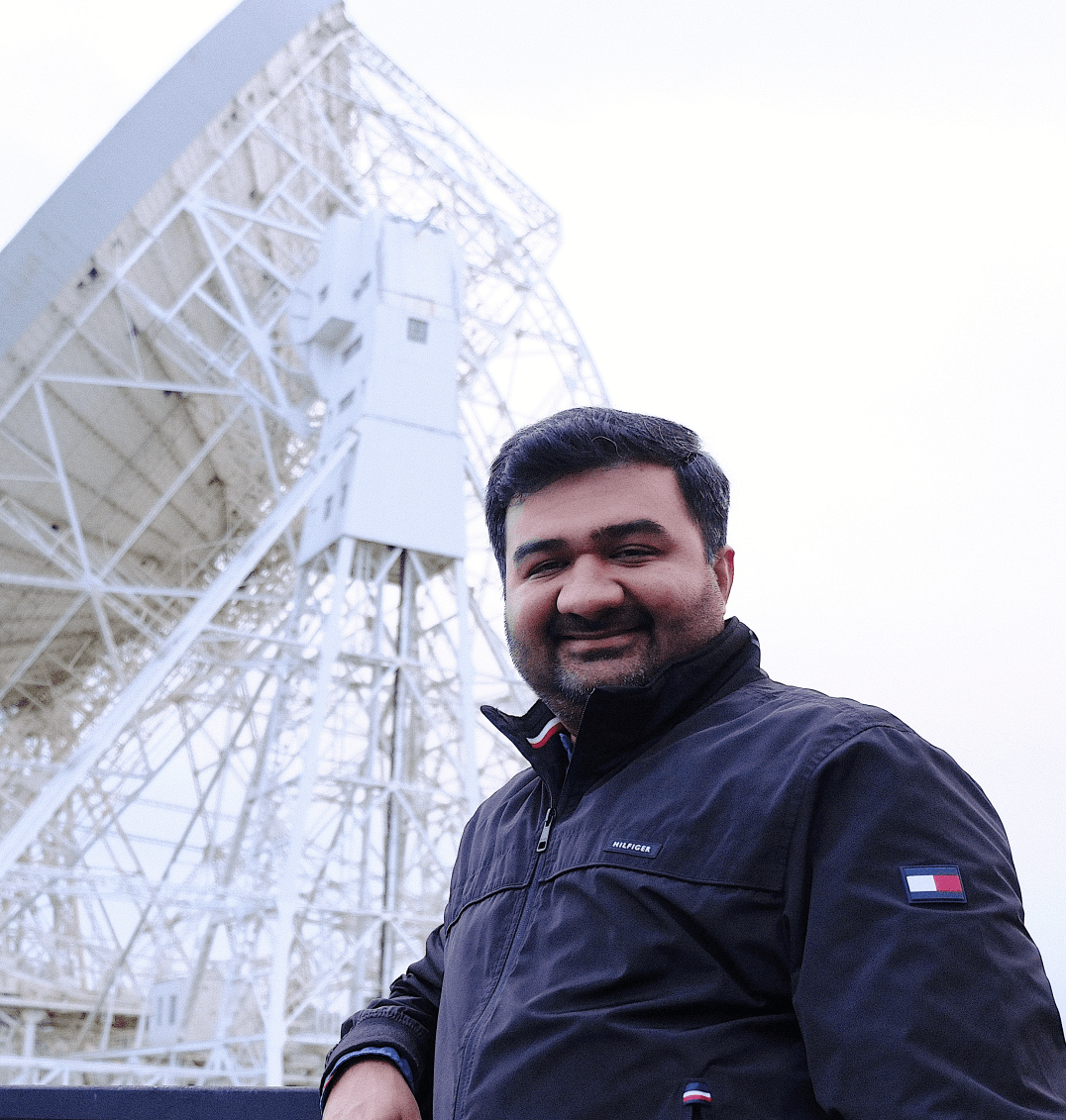
Gajjar is a project scientist for Breakthrough Listen’s international collaboration, coordinating technosignature campaigns across radio observatories in China, India, Ireland, Sweden, Italy, France, and the UK. He is perhaps best known for detecting the first fast radio burst at the highest radio frequencies, using a GPU-accelerated, machine-learning pipeline he built called SPANDAK. With close to 100 publications and a focus on novel signal-search algorithms, his recurring theme is methodological: are we searching the right way, for the right kinds of signals?
The work in this talk was supported by a SETI Institute STRIDE grant and carried out with research assistant Grayce C. Brown, who Gajjar credits with much of the modeling.
More About Gajjar’s Work in Advancing the Search for Technosignatures
Gajjar’s talk centered on an effect that previous radio SETI work has overlooked: stellar activity and plasma turbulence near a transmitting planet can broaden an otherwise ultra-narrow signal, spreading its power across more frequencies and making it more difficult to detect in traditional narrowband searches.
Previous studies, going back to Cordes and Lazio’s foundational 1991 work, examined how the interstellar medium scatters signals over light-years of travel. Gajjar’s group instead looked at the interplanetary medium of the alien system itself, the exoplanetary “space weather” a signal must first punch through.
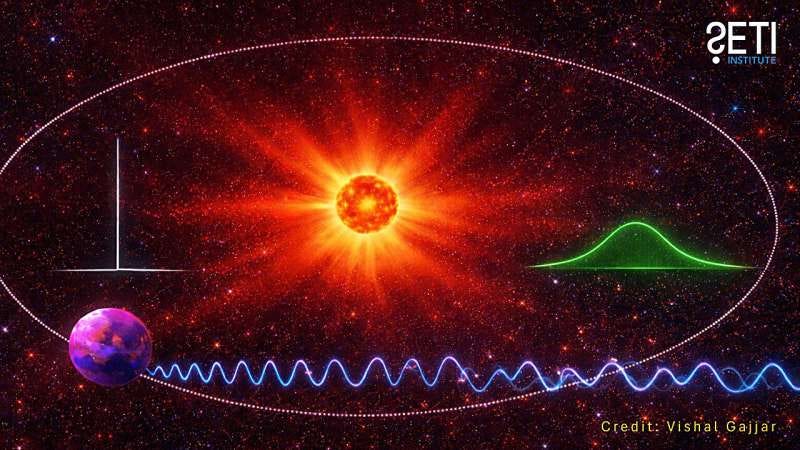
The physics is the same twinkle that makes stars shimmer or sunlight dance on a pool floor.
A star’s wind is clumpy and turbulent, and that turbulence imprints phase fluctuations on any narrow signal passing through. In the frequency domain, that smears a sharp spike into a broad, faint feature with long Lorentzian tails, exactly the wrong shape for pipelines tuned to find razor-thin spikes.
To ground this in reality, Gajjar and colleagues compiled what is likely the largest collection of spectral-broadening measurements from real spacecraft carrier waves, observed as probes passed behind the Sun, then derived how broadening scales with distance from a star.
Applied to a simulated survey of the nearest million stars, the results are striking:
At 1 GHz, roughly 70% of systems produce more than 1 Hz of broadening, and over 30% produce more than 10 Hz.
At 100 MHz, more than 60% of systems exceed 100 Hz of broadening.
M-dwarfs, which make up about 75% of all stars and host close-in habitable zones, are hit hardest.
A coronal mass ejection is encountered less than 3% of the time, but when it is, it can wash out a signal entirely, adding more than a thousand Hz of broadening.
The consequences may be highly impactful to technosignature searches.
Gajjar noted that if Breakthrough Listen Candidate 1 (BLC1), the famous 2021 signal near Proxima Centauri, had truly originated on Proxima Centauri b, it should have shown anywhere from 100 to tens of thousands of Hz of broadening. It did not. The same logic applies to heavily targeted systems like TRAPPIST-1. His provocative bottom line: this bias may be one quiet contributor to the “Great Silence.”
Key Takeaways
A transmitting planet’s own star can blur a narrowband signal before it ever leaves the system, an effect distinct from, and sometimes stronger than, interstellar scattering.
The distortion redistributes signal power into broad Lorentzian wings, suppressing the peak signal-to-noise that conventional narrowband pipelines rely on.
M-dwarf systems, the most common stars and frequent SETI targets, are the most affected, especially at lower observing frequencies like those planned for SKA-Low.
Decades of non-detections and reported sensitivity limits may need to be revisited; some searches could have recorded broadened signals and discarded them.
The effect could also be turned into a tool: a Lorentzian-shaped signal is recognizable, and broadening tied to a planet’s transit could even help confirm that a signal comes from a world orbiting a star.
This work reframes a long-standing assumption in radio SETI at a pivotal moment, just as next-generation instruments prepare to survey the low-frequency sky where these effects bite hardest.
By quantifying how stellar environments reshape signals, Gajjar offers a way to match searches to what actually arrives at Earth rather than to an idealized transmission, and they hint that the cosmos may not have been as silent as we thought.
This video was included in the proceedings of the International Astronomical Union (IAU) symposium #404, Advancing the Search for Technosignatures, hosted by Blue Marble Space.
Stay tuned as we explore the boundaries of knowledge in technosignature science!
Thanks for joining us here with Planetary Perspectives, an editorial endeavor and science communication project from Blue Marble Space.

Sources and Materials to Check Out
Gajjar, V. & Brown, G. C. (2026). Exo–IPM Scattering as a Hidden Gatekeeper of Narrowband Technosignatures. The Astrophysical Journal, 999(2), 210. https://iopscience.iop.org/article/10.3847/1538-4357/ae3d33 (DOI: 10.3847/1538-4357/ae3d33)
SETI Institute STRIDE grant announcement (funds this project)
Phys.org coverage of the study
Sci.News coverage