

Could a handful of moon dust hold the fingerprints of a civilization that died out a billion years before humans existed?
Dr. Lewis Pinault thinks it’s worth checking, and that’s part of what Pinault presented during IAUS404: Advancing the Search for Technosignatures.
About the Presenter
Dr. Lewis Pinault holds a PhD from Birkbeck College, University of London, and works today as an affiliate scientist with the SETI Institute, while also serving as a research fellow at the Centre for Planetary Sciences, a joint program between University College London and Birkbeck. Based in Tokyo, his background is in meteoritics and impact studies, and he currently collaborates closely with asteroid sample-return teams at Japan’s space agency, JAXA.
Pinault’s research centers on a distinctly small-scale question with large-scale implications: whether engineered particles at the micron and submicron scale, dust-sized fragments of alien technology, could survive interstellar transport and settle into the lunar regolith. He pursues this through a combination of orbital dynamics, impact physics, and computer vision, and has extended the same detection tools to a very different target: the long-lost Soviet Luna 9 lander.
More About Pinault’s Work in Advancing the Search for Technosignatures
"The dust of other technological societies would actually have had ample opportunity to reach us from across the entire span of the Milky Way."
—Lewis Pinault
Pinault’s talk, presented alongside collaborators Brian Lacki (Breakthrough Listen), Andrew Siemion (SETI Institute), and Ian Crawford (UCL/Birkbeck), built on a decades-old proposal by Ukrainian researcher Alexander Arkhipov, who suggested in the early 1990s that debris from other civilizations might drift between star systems on radiation pressure and stellar winds. Pinault’s team has extended that idea down to the micron and submicron scale, where particles are small enough to ride solar radiation pressure through the heliosphere without being deflected away.
The Moon, Pinault argued, is an unusually good place to look for this kind of evidence. Unlike Earth, it offers:
No atmosphere or plate tectonics to erase or bury impact evidence
Over four billion years of continuous, largely undisturbed exposure
A well-mixed upper regolith layer, roughly a meter deep, that likely acts as a natural depository for infalling material
Because interstellar particles this small arrive as hypervelocity impactors, at speeds that can exceed 10 kilometers per second, the challenge isn’t just finding something that might not be there at all, but distinguishing artificial debris (and even its impact craters) from natural micrometeorite material. Pinault’s group is now developing a computer vision system for exactly this kind of particle and sample analysis, aiming eventually to screen microscopy imagery from missions like Apollo, Chang’e-6, and JAXA’s Hayabusa2 for anomalies at scale.
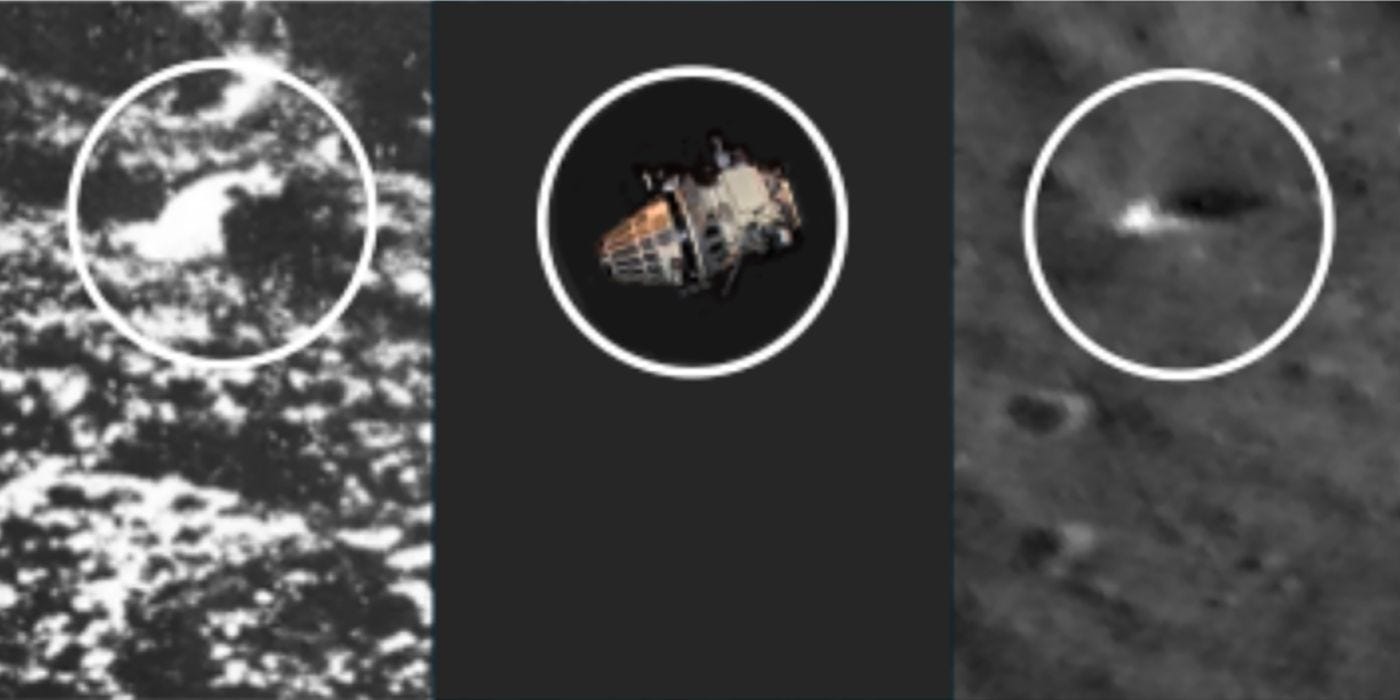
That search philosophy, using AI-assisted pattern recognition to find rare signals in oceans of ordinary data, grew out of a related but separate line of Pinault’s work: a model called YOLO-ETA (You Only Look Once – Extraterrestrial Artefact), trained on orbital and landing-site imagery rather than particle samples. In a study published in npj Space Exploration with Crawford and Hajime Yano, Pinault’s team used YOLO-ETA to search for the USSR’s Luna 9 spacecraft, missing since its historic 1966 landing. The model successfully identified the known Luna 16 site in a validation test, then flagged promising Luna 9 candidates near 7.03° N, –64.33° E.
Pinault notes the Luna 9 search connects to his technosignature interests more directly than it might first appear. If self-replicating micron-scale particles were engineered to draw on the energy and materials of their impacts, larger “grown” structures might eventually result, even after being ground into the regolith over hundreds of millions of years, and cataloguing known Earth spacecraft hardware is partly a testbed for the capability to recognize such objects. He also sees a secondary role for orbital computer vision: identifying which patches of the Moon are worth sampling first, whether by soil maturity, the preservation potential of pit craters, or (as his paper discusses) signs that a region may have been deliberately targeted.
Key Takeaways
Micron-scale interstellar dust, if it exists, could feasibly reach the Earth-Moon system after traveling for millions to billions of years on radiation pressure and stellar winds.
The lunar regolith’s age, stability, and lack of erosion make it a strong archive for this kind of search, compared to Earth’s active geology.
AI-driven computer vision, developed initially for lunar landing-site analysis, has already helped narrow the search for a real, historically lost spacecraft, the Soviet Luna 9 lander, and Pinault sees the same approach eventually aiding the technosignature search itself.
Distinguishing artificial debris from ordinary micrometeorite material may require studying impact-crater morphology as much as the particles themselves.
Even a null result from sampling a modest volume of lunar material could help place quantitative limits on the number of past technological civilizations in the galaxy.
Pinault’s work sits at an unusual intersection of astrobiology, planetary geology, and machine learning, treating the Moon less as a dead rock and more as an unopened time capsule. If micron-scale technosignatures exist, the tools to find them, computer vision models trained to spot the improbable in oceans of ordinary data, are only now becoming powerful enough to try.
This video was included in the proceedings of the International Astronomical Union (IAU) symposium #404, Advancing the Search for Technosignatures, hosted by Blue Marble Space. Stay tuned as we explore the boundaries of knowledge in technosignature science!
Editorial Note: Since IAUS404, the fuller quantitative study behind this talk has been posted to arXiv and is currently in peer review at the International Journal of Astrobiology.
Readers interested in the full analysis can find the preprint here.
Thanks for joining us here with Planetary Perspectives, an editorial endeavor and science communication project from Blue Marble Space.
