
W2W (Waste to Wow)
A Planetary Perspective from Bhargabbi Baneerjee on Building Inclusive Bioeconomies


Biotechnology is often associated with advanced laboratories, cutting-edge equipment, and large-scale industrial applications. But what if the next wave of innovation didn’t just emerge from high-tech environments, but from the grassroots, and from the everyday materials we discard without a second thought?
My journey from research during my college years to science communication at BMS, and later into the startup ecosystem during my professional journey revealed a recurring disconnect. While scientific knowledge continues to advance rapidly, its accessibility and real-world application remain limited. The gap between lab and market is especially evident for research labs, small industries and rural communities, where innovation often fails to translate into viable products.
Working at a venture studio after college brought me face-to-face with the startup world and inspired me to build something of my own. While I explored multiple ideas, I realized that biotechnology was my true calling, a space where I could meaningfully apply my knowledge. Around the same time, my mentor and professor, Dr. Samuel Jacob, who had been a guiding force throughout my academic and professional journey, was ideating his own venture. Our visions aligned, and I joined him, leading to the founding of Yaalee Biotech Solutions.

Today, Yaalee is led by three of us: Dr. Samuel Jacob, Co-Founder and Chief Product Officer; myself, Co-Founder and CEO; and Charu Manihar, Co-Founder and Chief Strategy Officer.
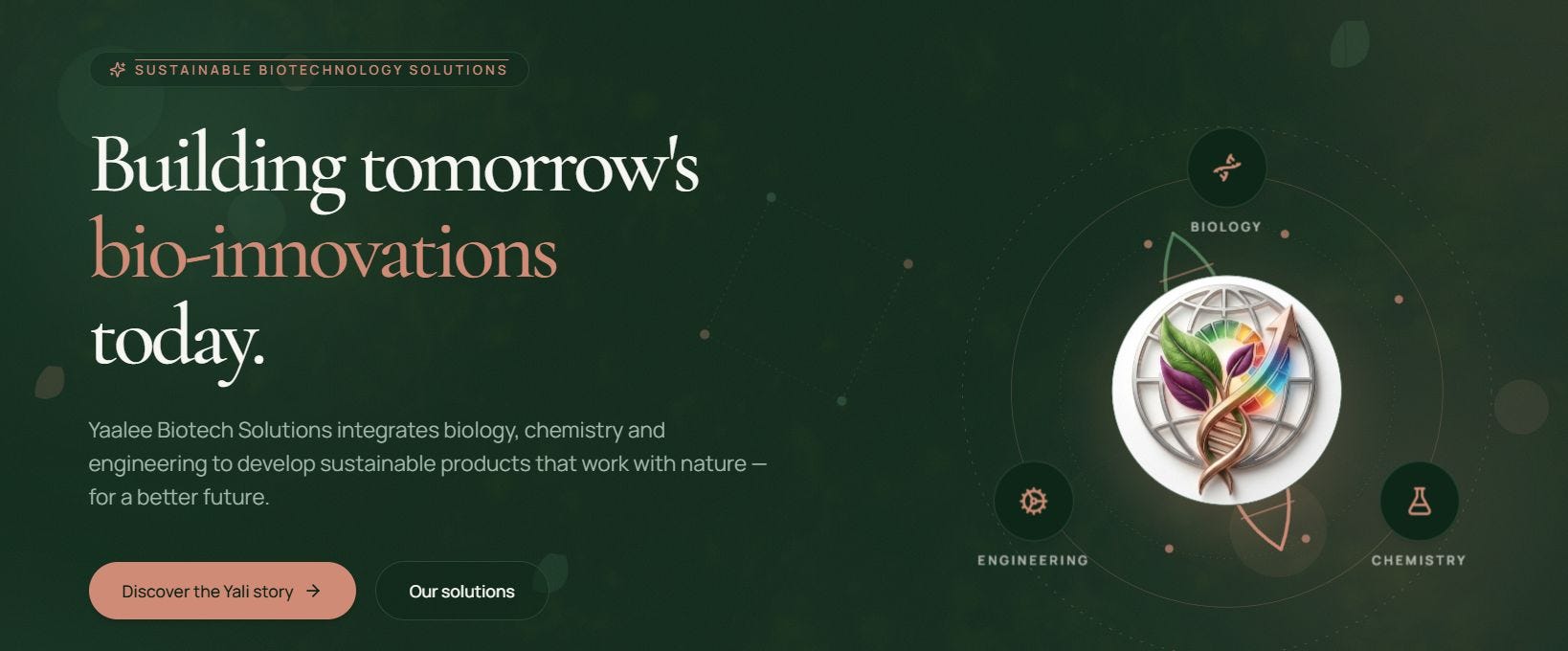
Yaalee operates on a Research-as-a-Service (RaaS) model, enabling small and medium-scale bio-industries to access affordable, application-driven research. At the same time, we are deeply focused on empowering rural communities, particularly women and youth, through education, skill development and entrepreneurship. We help transform grassroots ideas into market-ready products while also creating employment opportunities through product development initiatives.
A key pillar of our work is advancing the waste-to-wealth bioeconomy, transforming biological and industrial waste into valuable, market-ready solutions. This not only addresses environmental challenges but also creates decentralized economic opportunities, reducing migration and strengthening local ecosystems.
At its core, Yaalee is about bridging gaps, between science and society, innovation and accessibility, and local knowledge and global impact.
Looking ahead, our focus is on scaling this model: building stronger industry collaborations, expanding rural innovation networks, and developing proprietary technologies that contribute to a more circular, inclusive, and resilient bioeconomy.
Check out more about Yaalee Biotech Solutions at the website yaaleebiotech.com.
And follow the company on LinkedIn for active updates!
Bhargabbi Baneerjee is a biotechnology graduate with a growing focus on building impactful ventures at the intersection of science, sustainability, and entrepreneurship. She has gained exposure in science communication as a Research Associate and Visiting Scholar under Dr. Graham Lau at BMSIS.
Her professional journey includes working at the Founder’s Office at River Venture Studio, a Singapore-based Industry 5.0 venture studio, where she was closely involved in early-stage startup development, investments, strategy and ecosystem building. This experience provided her with hands-on exposure to the startup landscape and reinforced her interest in translating scientific knowledge into scalable, real-world solutions.
Currently, Bhargabi is the Co-Founder and CEO of Yaalee Biotech Solutions, focused on enabling accessible research for bio-industries, empowering rural entrepreneurs, and advancing waste-to-wealth innovations.
Beyond her professional work, she is an avid reader and runs a book blog on Instagram, where she has been sharing reviews for over a year and has built a community of 6,000+ followers.
She aspires to build a biotech enterprise that drives both economic growth and meaningful social impact.
 | A guest post by
|