

Before you can find a technosignature from aliens, you have to agree on what one is, and how you’d know if you’d actually detected it.
These three video posters, presented at IAUS404: Advancing the Search for Technosignatures in March 2026, each pick at a different assumption baked into that search: whether a “sensitive” survey really is sensitive, whether technosignatures have to be radio waves and megastructures at all, and whether the categories of “life” and “technology” can be cleanly separated in the first place.
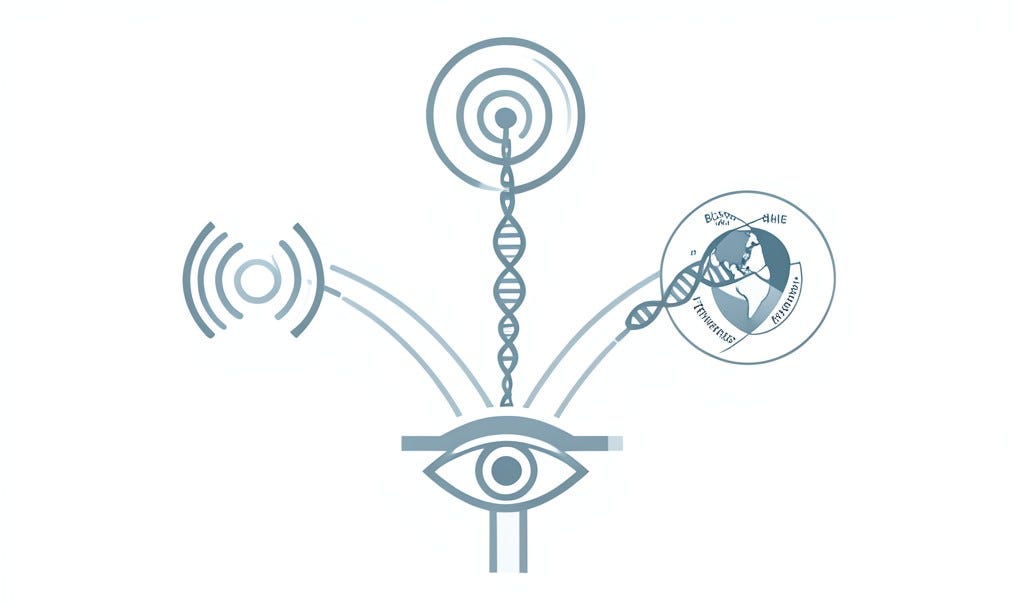
Taken together, they’re less about new detections than about the conceptual scaffolding that makes any detection meaningful, and that’s part of what Eric Korpela, Ivelina Kadiri, and Lukáš Likavčan presented at IAUS404 in March 2026.
Eric Korpela & David Anderson: Threshold Is Not Sensitivity
Eric Korpela and David Anderson are, respectively, a research astronomer and a computer scientist at the Space Sciences Laboratory, University of California, Berkeley. Korpela directs SETI@home, the long-running distributed-computing radio SETI project; Anderson built the BOINC volunteer-computing platform that made it possible.
Their poster challenged a habit in the technosignature literature: reporting a single “detection threshold” number, calculated from the radiometer equation, as if it were the survey’s true sensitivity. In practice, the pipeline steps that come after that threshold, filtering out radio interference and discarding most flagged detections, can just as easily throw out a real signal. Korpela and Anderson argued the better approach is double-blind injection: seeding a search with thousands of synthetic “test” signals of varying strength and letting the pipeline process them without knowing they’re fake, then checking which ones survive to determine the search’s actual sensitivity. Since the talk, this is exactly the method their SETI@home team used in analyzing 21 years of Arecibo data, described in two 2025 papers in The Astronomical Journal: injecting roughly 3,000 synthetic “birdie” signals helped the team narrow 12 billion raw detections down to about 100 candidates now being followed up with China’s FAST telescope.
Ivelina Kadiri: Genomic Personas as Human Technosignatures
Ivelina Kadiri is a doctoral researcher in the Marketing Department at the University of Economics – Varna, Bulgaria, where her work sits at the intersection of genetic data, marketing, and the space economy.
Kadiri’s poster took technosignature thinking in an unusual direction: back toward Earth. Her doctoral research builds an “astronaut genetic persona mapping” framework, pulling genetic markers for radiation resilience and cognitive stability, drawn from resources like NASA’s GeneLab, into behavioral and mission-planning profiles. She argued that these databases meet the field’s own criteria for a technosignature: they’re complex, non-random, deliberately designed, and self-referential, encoding information about the very biological systems that produced them. If so, humanity’s genomic infrastructure is itself a detectable, planetary-scale signature of intelligence, which she suggested creates a governance gap, since no legal framework currently addresses whose rules apply to genetic data collected in orbit or deep space.
Lukáš Likavčan: Substrate-Agnostic Ecologies
Lukáš Likavčan is a philosopher at the Institute of Philosophy, Slovak Academy of Sciences, whose work traces the intersections of emerging technology, ecology, and astronomy; he also holds affiliations with NYU Shanghai and the Berggruen Institute’s Antikythera program.
Likavčan’s poster is the most conceptual of the three, and arguably the one that ties the other two together. He walked through what he called a triple abstraction. First, following astrobiologist Michael Wong’s proposal to replace narrow definitions of “life” with the broader concept of “genesity,” or a planet’s general capacity to generate novelty. Second, applying that same widening to “technology,” building on Jill Tarter’s definition of a technosignature as any environmental modification, which collides with niche-construction theory (after biologist Kevin Laland), since living things have been modifying their environments for billions of years too. Once both definitions are stripped of Earth-centric assumptions, Likavčan argued, the line between a biosignature and a technosignature gets genuinely blurry, which is where his proposed “substrate-agnostic ecology” comes in: a framework, echoing Ernst Haeckel’s original 1866 definition of ecology, focused simply on agents and their relationships to an environment, regardless of what those agents are made of. Since the talk, Likavčan has published this argument as a preprint, for readers who want the fuller philosophical case.
You can also read Lukáš’ writing and explorations here on Substack as Substrate Agnostic!

Key Takeaways
A survey’s reported “detection threshold” isn’t the same as its real sensitivity; later pipeline stages can discard genuine signals along with noise.
Injecting synthetic test signals into a search, without telling the analysis team which ones are fake, is emerging as the standard way to measure a pipeline’s true performance, and it’s already been used at scale in SETI@home’s Arecibo data.
Databases of human genetic and behavioral information could, by the field’s own definitions, qualify as technosignatures, raising new questions about data governance in space.
Widening the definitions of “life” and “technology” to avoid Earth-centric bias makes the boundary between biosignatures and technosignatures harder to draw cleanly.
All three posters suggest that progress in technosignature science depends as much on sharpening definitions and methods as on gathering more data.
Read individually, these three posters look unrelated: an instrumentation problem, a marketing-adjacent thought experiment, and a philosophy paper.
Read together, they trace a single thread running through IAUS404: Advancing the Search for Technosignatures: before the field can claim a detection, or rule one out, it has to be honest about what it’s actually measuring and what it’s willing to count as a signal.
These videos were included in the proceedings of the International Astronomical Union (IAU) symposium #404, Advancing the Search for Technosignatures, hosted by Blue Marble Space.
Thanks for joining us here with Planetary Perspectives, an editorial endeavor and science communication project from Blue Marble Space.

FFT alone reduces the search aperture to a pin hole.