What's in a Name?
How Personalised Science Communication Is Quietly Changing Who Space Belongs To


A Planetary Perspective by Rajat Bhushan Gupta
What’s in a name?
Shakespeare’s Juliet thought not much. NASA disagrees, and they may be right.
In April 2026, NASA’s Kennedy Space Center posted something on social media that stopped people mid-scroll: “This planet can spell your name, literally.” It was promoting Your Name in Landsat, a tool that lets anyone type their name into a web interface and watch it spelled out in real satellite imagery, a river bend in Brazil for the letter g, a Norwegian lake curled into an A, a salt flat in Central Asia forming an S. Each letter is a real place on Earth, sourced from over 50 years of continuous observation by the Landsat program. You type a name. The planet writes it back.
It sounds like a gimmick. It isn’t. It is, in fact, one of the cleanest examples of what the best science communication in planetary science actually does: it makes something vast feel personal.
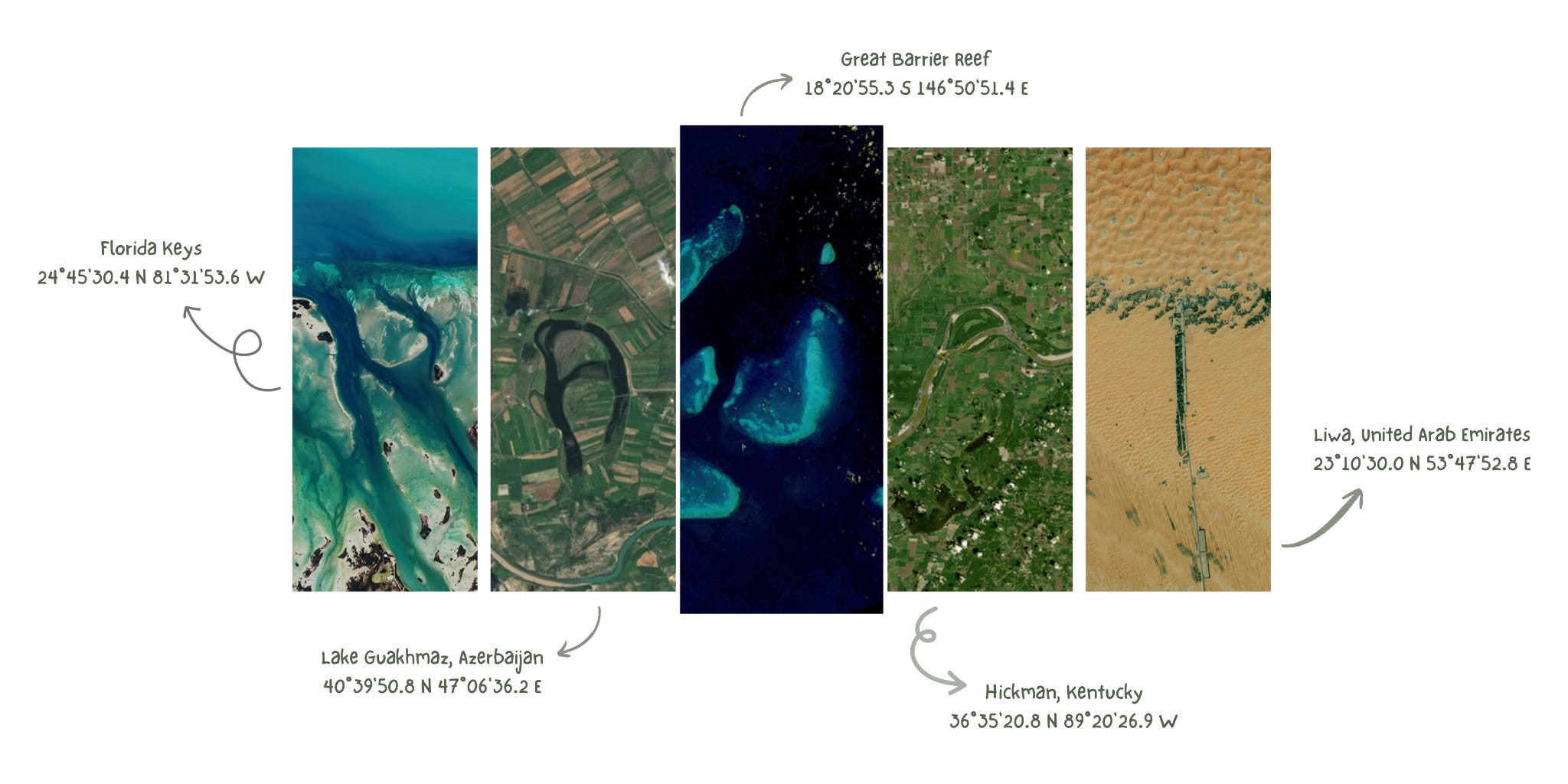
My name, your name, everybody’s name, everywhere
The Your Name in Landsat tool is the newest in a long and quietly brilliant lineage of NASA campaigns built around a single, deceptively simple idea: put the person’s name into the mission.
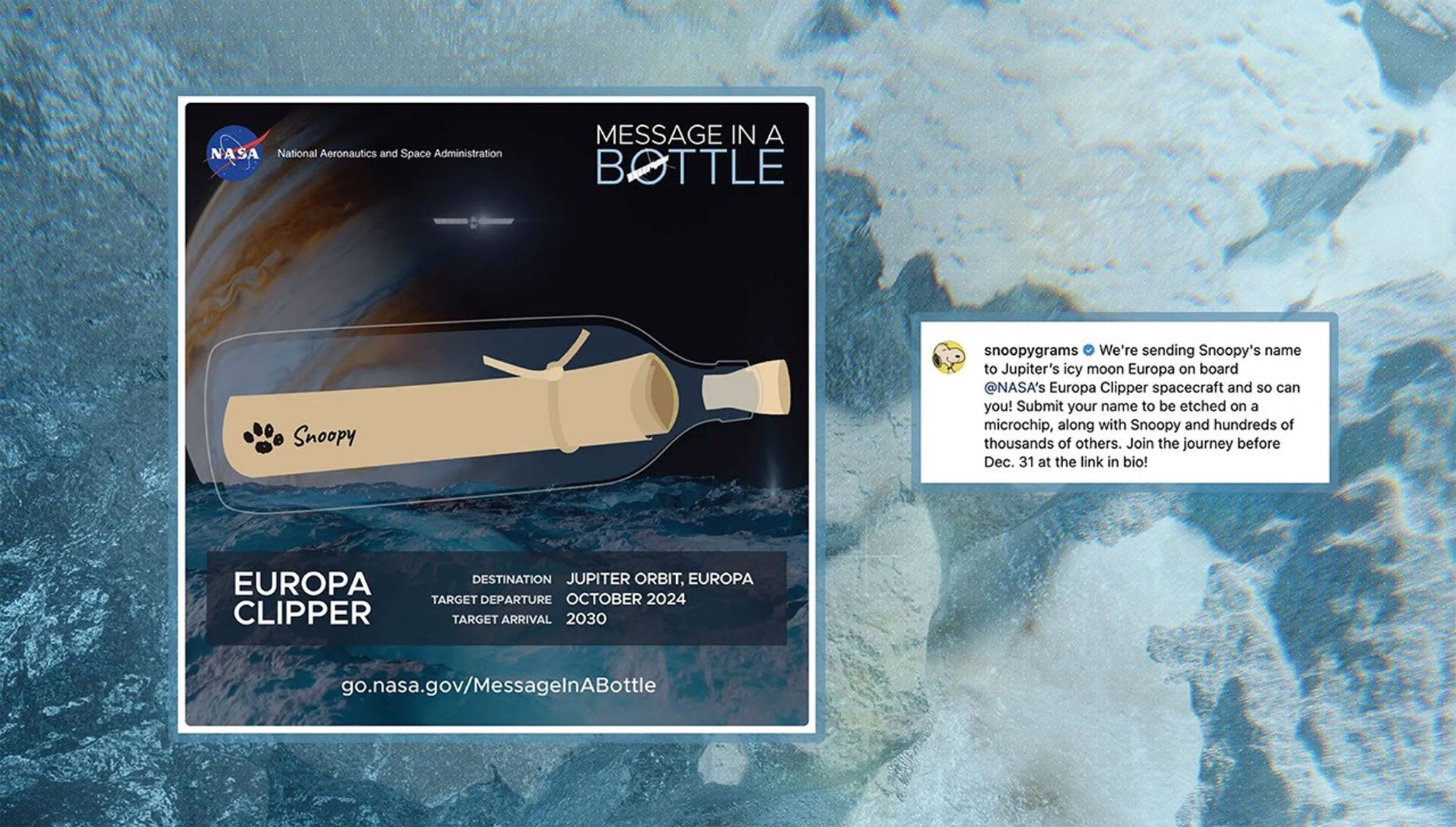
Between June and December 2023, NASA’s Message in a Bottle campaign collected over 2.6 million names to send to the Jupiter system aboard the Europa Clipper spacecraft. Technicians at NASA’s Jet Propulsion Laboratory’s Microdevices Laboratory used an electron beam to stencil them onto a dime-sized silicon microchip, each line of text smaller than 1/1000th the width of a human hair. That chip now rides on the exterior of the Europa Clipper, launched in October 2024, currently making its way to Jupiter’s moon Europa, an ice-covered ocean world that may hold conditions for life. The chip is attached to a metal plate engraved with an original poem, In Praise of Mystery: A Poem for Europa, written by U.S. Poet Laureate Ada Limón.
The names, the poem, and the spacecraft will make roughly 50 close flybys of Europa before the mission ends.
Before Europa, there was Mars.
When the Perseverance rover safely touched down in Jezero Crater on February 18, 2021, it was also a safe landing for nearly 11 million names on board, written on three fingernail-sized chips, stenciled using an electron beam. There are names on the Parker Solar Probe at the Sun. Names also flew around the Moon on Artemis II in 2026 on an SD card loaded aboard the Orion spacecraft, with over 1.8 million “boarding passes” claimed.
And now a planet is writing names back in its own handwriting, in glaciers and river deltas and desert dunes, assembled from half a century of satellite photographs.
But I want to stay on the Mars boarding pass for a moment, because I think it is the most underrated piece of science communication NASA has ever produced.
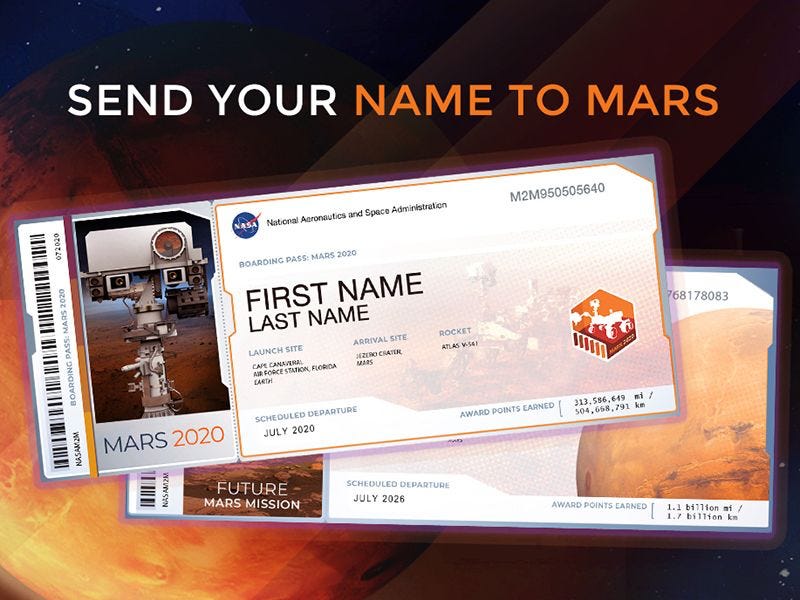
When you sign up for the Send Your Name to Mars campaign, what you receive in return is a boarding pass. Not a certificate. Not a confirmation email. A boarding pass, formatted exactly like the document an airline hands you before a flight. It has your name on it. It has a departure point: Earth. It has a destination: Mars. It lists the mission, the spacecraft, the distance. It even tallies your frequent flyer miles.
Think about what a boarding pass means. It is the ultimate document of permission and arrival. When you hold one in your hands at an airport, it means everything has been confirmed, your seat is real, your journey is happening, you are going. The anxiety dissolves. You are cleared for departure.
Now imagine you are a sixteen-year-old who wants to become an astrobiologist. You have spent years reading about Mars, about the possibility of ancient microbial life, about what the regolith of Jezero Crater might one day tell us. And then NASA hands you a boarding pass. With your name on it. For Mars.
That piece of paper, and the feeling it produces, is not a gimmick. It is a precise, intelligent act of psychological inclusion. It says: you are not watching this mission. You are on it. It costs NASA nothing. It costs the participant nothing. And it plants something in that sixteen-year-old that no lecture, no documentary, and no press release ever could, the feeling that space is a place they already have a seat on.
And now a planet is writing names back in its own handwriting, in glaciers and river deltas and desert dunes, assembled from half a century of satellite photographs.
Why does this work? Because a name is not a data point. It’s the most personal thing a person owns. When you see your name written in the curves of an Amazon river, or know it is etched on a microchip sailing toward Europa, something shifts. The mission is no longer something you watch. It becomes, in some small but real way, yours.
This is the insight that NASA has understood better than almost any other space agency in the world, and the gap between NASA and everyone else on this front is something worth talking about honestly.
The Pale Blue Dot and the Golden Record: When Science Becomes Mythology
Before the name campaigns, before interactive tools, there were two moments that established what was possible when planetary science stopped merely informing and started making people feel.
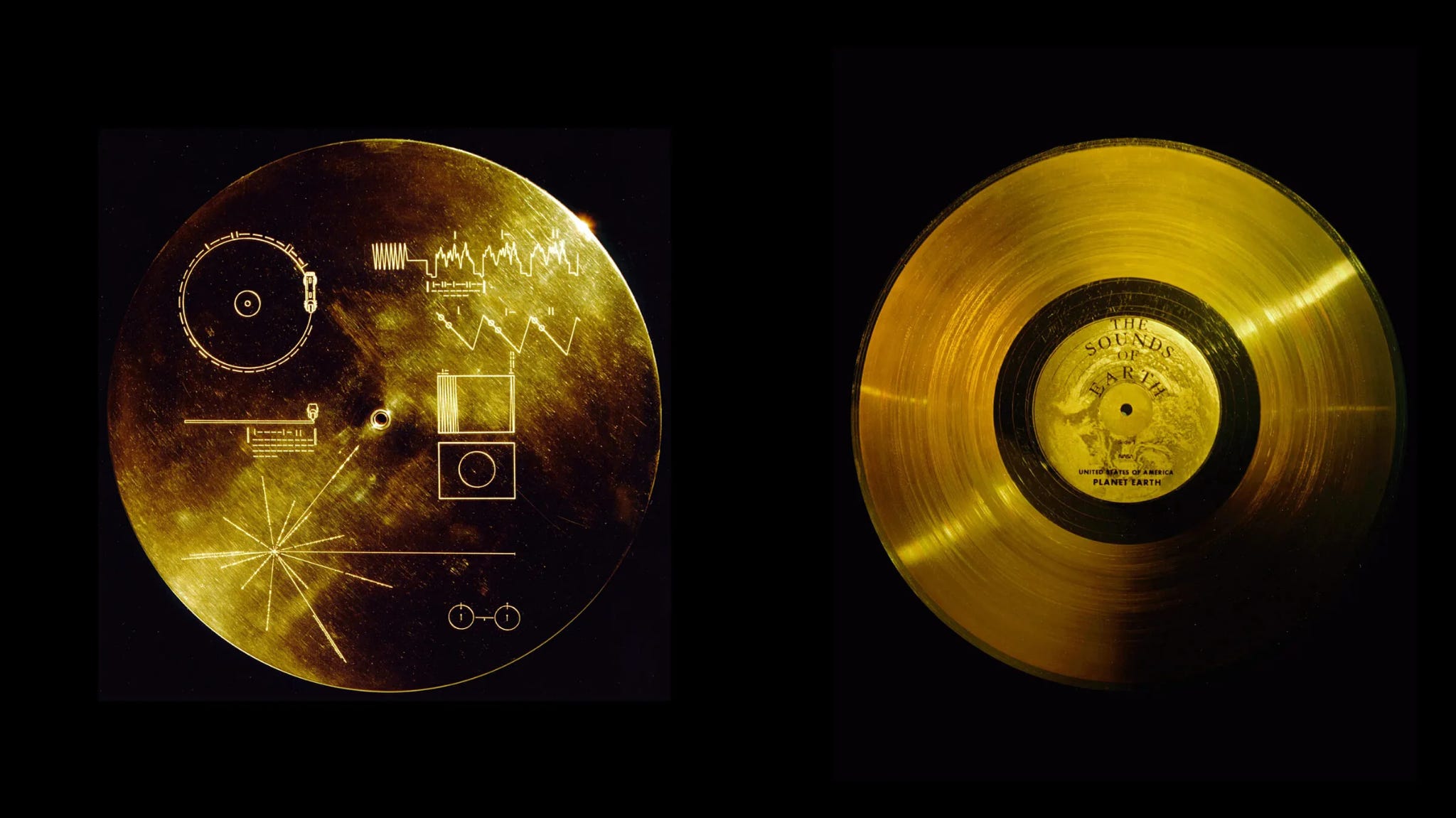
The first was the Voyager Golden Record. In 1977, Carl Sagan and a small team at NASA placed aboard both Voyager 1 and Voyager 2 a 12-inch gold-plated copper disk encoded with sounds and images intended to communicate life on Earth to any intelligence that might one day intercept it. The record contained sounds and images selected to portray the diversity of life and culture on Earth, natural sounds, musical selections from different cultures and eras, and spoken greetings in 55 languages. The chance that any extraterrestrial will find it is essentially zero, and Sagan knew this. The Golden Record did not succeed as interstellar communication. It succeeded as terrestrial mythology. More people can describe the Golden Record than can explain what scientific instruments the Voyager probes actually carried.
The real audience was always us.
The Golden Record was an invitation to humanity to ask: what do we value enough to send into the void? That question is not scientific. It is civilizational. And by embedding it inside a planetary science mission, Sagan transformed a spacecraft into a philosophical event.
The second moment was the Pale Blue Dot. On February 14, 1990, Voyager 1, then 3.7 billion miles from the Sun, turned its camera toward Earth one last time at Sagan’s insistence, before its imaging system was shut down forever. The image inspired the title of Sagan’s book Pale Blue Dot: A Vision of the Human Future in Space, and the speech he wrote to accompany it has since been translated into dozens of languages, set to music, and recited at everything from funerals to graduation ceremonies. Visitors to the Jet Propulsion Laboratory auditorium, when the full solar system portrait was assembled on a 20-foot-wide composite on the wall, kept touching the dot that was Earth.
That is what good science communication does. It doesn’t just explain. It makes people reach out and touch something.
The NASA Gap: Why Is Only One Agency Doing This?
Here is where I want to say something that gets glossed over in most discussions of planetary science communication: almost every major mission in our solar system is a joint effort. Europa Clipper carries instruments from teams in the US and Europe. BepiColombo, currently en route to Mercury, is a joint ESA-JAXA mission. ISRO’s Chandrayaan-1 carried payloads from NASA, ESA, and Bulgaria. The James Webb Space Telescope is the result of a partnership between NASA, ESA, and the Canadian Space Agency. The list goes on.
And yet, when H&M wants to put a space agency logo on a hoodie, they go to NASA. When Ariana Grande makes a space-themed music video, it’s NASA. When a teenager posts an astro-aesthetic on Instagram, the badge they are wearing says NASA. Apparel makers like Target, Nike, Walmart, Forever 21, Topshop, Urban Outfitters, and H&M have all put the NASA “meatball” or “worm” logo on their merchandise. Pop singer Ariana Grande had a song and an entire merchandising line about NASA. Adidas, Swatch, and Vans also released lines within the past decade.
Why? Part of the answer is structural. Because NASA is a government agency, much of its assets, including photos, logos and even technology designs, are in the public domain. If a company wants to print NASA logos on t-shirts or coffee mugs, it just has to send an email to NASA’s merchandising department. NASA does not profit from it and allows its use by brands, under certain conditions, all it takes is an email to obtain permission to use the logo. That structural openness, deliberate or not, has turned NASA into a genuinely global cultural brand in a way that no other space agency has achieved.
But the deeper reason is communicative.
NASA has spent decades investing in the kind of creative, participatory, emotionally resonant outreach described in this piece. The name campaigns. The Pale Blue Dot. The boarding passes and microchips. The open data. The social media presence that now reaches 82 million followers on Instagram alone. A NASA multimedia liaison explained that the agency is experiencing a “golden age of interest,” thanks in part to social media posts that show off great photos from the Hubble Space Telescope, the Mars Curiosity Rover and astronauts on the International Space Station. “People get really excited about it,” he said.
ESA does good science communication, Thomas Pesquet’s social media dispatches from the ISS have been widely celebrated, but it operates across 22 member states with different languages, political priorities, and funding structures, making a coherent global identity difficult to sustain. The ESA Director General himself acknowledged being “very humbled” and “proud” to see the ESA logo on the SLS rocket alongside NASA’s for Artemis, a telling reflection of the asymmetry in public visibility between the two agencies.
ISRO’s situation is even starker, and the criticism from within India’s own scientific community is worth quoting directly. “A kid growing in India learns about NASA before it does ISRO because NASA puts so much effort into taking its work to its citizens and the public, from the smallest of things to the biggest,” one post observed; a post that had garnered at least 11,000 views when the story was reported. The Indian science community is currently waging a war against the veil around ISRO-supported operations, fighting with memes, personal anecdotes, and a carefully crafted list of its work which has remained hidden from public discourse. A senior ISRO scientist acknowledged the agency had “gotten better” at PR but accepted that “compared to its counterparts, such as NASA or ESA, there is a long way to go.” One of the reasons fewer students aspire to work at ISRO is low visibility and engagement, agencies like NASA and ESA invest heavily in public science communication, documentaries, school visits, and competitions.
This is not a failure of scientific capability.
ISRO landed on the Moon’s south pole for about $75 million, less than the production budget of the Hollywood film Gravity. JAXA successfully landed the SLIM probe on the Moon and retrieved asteroid samples with Hayabusa2. These are extraordinary achievements. The science is there. The communication infrastructure around it, at a global level, is not, at least not yet.
Is NASA enough? My honest answer: no, and not because NASA is doing anything wrong. It’s because these missions are joint. When BepiColombo finally enters Mercury orbit in 2026, it will carry a Japanese magnetometer and an ESA spectrometer and years of work by scientists across two continents. The public’s relationship with that mission should reflect that. It shouldn’t be filtered exclusively through one national agency’s communication apparatus, however good that apparatus is. The people of Japan and the people of Europe paid for that mission. They deserve to feel it belongs to them too.
The Tax Argument: Why This Is Not Optional
Let me be direct about something. Space missions cost billions of dollars of public money. NASA’s annual budget runs to over $25 billion. ESA’s is around €10 billion. ISRO operates on roughly $1.5 billion. Every rupee, every euro, every dollar comes from taxpayers, most of whom will never work in the space industry, will never publish a paper in planetary science, and will never be asked directly whether they think this spending is worthwhile.
That creates an obligation. Not a PR obligation, a democratic one.
The public is not a passive beneficiary of space exploration. They are its funders and, in the deepest sense, its owners. When they feel excluded from the story, when space feels like something that happens to scientists and governments and defence contractors, not to ordinary people, the foundation of political and financial support erodes. Progress in space science depends upon public dollars, and vigorous and innovative education and outreach programs are important, and can be made even more effective.
The most effective answer to this is not more press releases or more documentaries, good as those can be. It is participation. When you send your name to Europa, you have a stake in what that spacecraft finds. When the planet writes your name back in satellite imagery, you have a relationship with Earth observation data that will make you more likely to care about the next Landsat generation. When you feel that a mission belongs to you, symbolically, imaginatively, you become an advocate for it. You share the news. You explain it to your kids. You push back when a politician threatens the budget.
NASA’s “fly your name” campaigns represent a fundamental shift in how space agencies are approaching public engagement, not just a charming PR tactic, but a strategic move to build lasting public support for ambitious, expensive, long-term space endeavors. The practice began in 1999 with the Stardust mission to Comet Wild 2, when names were etched onto microchips and sent toward a comet. It has since expanded into every corner of the solar system, gathering tens of millions of participants along the way.
Other agencies could do this.
ESA could run a “Your Name to Mercury” campaign for BepiColombo. JAXA could send names to Phobos aboard the Martian Moons eXploration mission, which is already planned. ISRO could build participatory campaigns around Chandrayaan-5 or the Gaganyaan crewed missions. The technology is trivially inexpensive, a microchip and an electron beam. The impact, measured in public ownership and long-term political will, is anything but trivial.
What the Cosmos Teaches About Communication
The underlying principle of everything described in this piece is not complicated.
The Golden Record worked because it made the question of human identity personal. The Pale Blue Dot worked because it made the question of Earth’s fragility personal. The name campaigns work because they make the question of space exploration personal. The Landsat tool works because it makes fifty years of Earth observation personal.
Personalisation is not a marketing technique. In science communication, it is a philosophical stance. It says: this science is not happening above you or around you. It is happening for you, with you, and, at least symbolically, by you. The cosmos is not a spectacle. It is a place you are part of.
That is the gap other agencies need to close. Not because they lack scientific ambition, they don’t, but because the boldest missions in history are being built jointly, funded jointly, and justified jointly. They should be communicated jointly too. The public of every participating country deserves to feel the mission is theirs. They paid for it. They should get a boarding pass too.
What’s in a name? As it turns out, everything. It is the smallest possible unit of personal investment, and the first step toward making a billion-dollar mission feel like it belongs to everyone who made it possible.
Rajat Bhushan Gupta is an engineer-turned-data scientist who followed his curiosity all the way to the Arctic. With a decade in data science and a Master's in the Biology of Extreme Environments (University of Naples Federico II), he writes at the intersection of astrobiology, science communication, and what it means to keep asking big questions.
Rajat is a science communicator with Blue Marble Space and the NASA SciComm Guild. He is an internationally featured photographer. At the core he is an educator, now joining Jagadguru Kripalu University (Odisha, India) as data science faculty. He loves mentoring young minds and believes science belongs to everyone.
Thanks for joining in for this Planetary Perspective, from Blue Marble Space.
 | A guest post by
|